


Table of Contents
- What Are Custom Print Tees and Why Choose Them
- Screen Printing vs Digital Printing: Which Method Suits You
- Best Fabric for Custom Tees: Quality and Comfort
- Designing Your Custom Print Tees: From Concept to File
- T-Shirt Printing Cost Breakdown: Understanding Your Investment
- Funny Birthday Shirts for Men: Popular Designs and Options
- Bulk Orders and No-Minimum Options
- Turnaround Times and Express Delivery
- Care and Longevity: Washing and Maintaining Your Custom Tees
- Frequently Asked Questions
Last Updated: October 4, 2026
What Are Custom Print Tees and Why Choose Them
Custom print tees are personalised clothing that express individuality, celebrate moments, or build brand identity. Whether you're designing a funny birthday shirt or corporate apparel, custom print tees offer flexibility that off-the-shelf options cannot match. You control the design, message, and quality. Unlike mass-produced garments, they tell a story, commemorate occasions, or showcase humour that resonates with a specific audience. For businesses, they're walking advertisements. For individuals, they're conversation starters.
At 123t Australia, we offer high-quality materials and unique designs. The difference between a custom print tee that lasts and one that disappoints comes down to printing method, fabric choice, and production attention to detail.
Screen Printing vs Digital Printing: Which Method Suits You
Screen printing and digital printing represent fundamentally different approaches, each with distinct advantages.
Screen printing pushes ink through a mesh screen onto fabric. It produces vibrant, durable colours that withstand repeated washing and works exceptionally well for bold designs with limited colour palettes. Setup costs are higher, making screen printing most economical for larger orders where per-unit cost drops significantly.
Digital printing (direct-to-garment or DTF) uses inkjet technology to apply designs directly to fabric. This method excels with photorealistic images, complex multicolour designs, and intricate details. Digital printing requires no screen setup, making it ideal for small runs, one-off pieces, or designs with unlimited colours.
The cost-benefit analysis depends on order size and design complexity. For a single funny birthday shirt with detailed graphics, digital printing is your answer. For 100 branded tees with a simple logo, screen printing delivers better value and durability.
Australian Textile Care Label Requirements specify durability standards for printed garments, and both methods can meet these requirements when executed properly.
Best Fabric for Custom Tees: Quality and Comfort
The fabric you choose determines how your custom print tee feels, lasts, and looks over time. Ring-spun cotton represents the premium option. The fibres are twisted together to create a smoother, stronger yarn, resulting in a softer feel, better colour retention, and greater durability. Most quality custom tees use 100% ring-spun cotton at 165 gsm (grams per square metre), which provides substantial weight without feeling heavy.
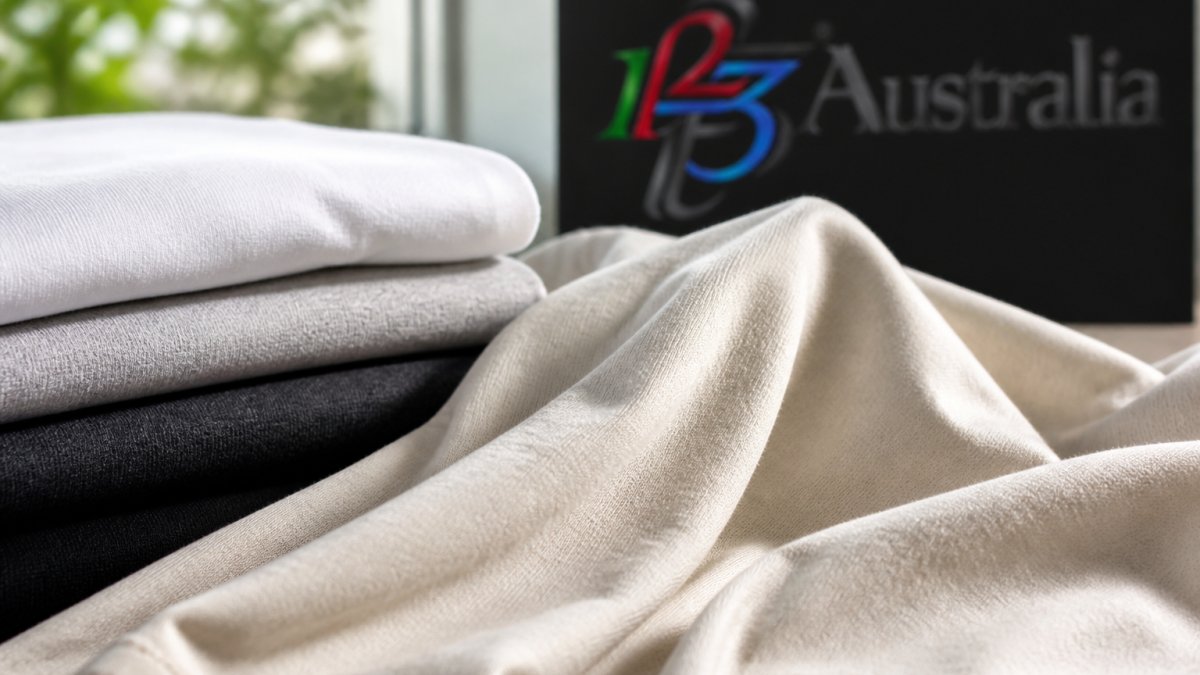
Fabric weight directly impacts longevity. A 165 gsm tee feels noticeably more substantial than cheaper alternatives at 120-140 gsm. The heavier fabric resists pilling and maintains shape through multiple washes.
Cotton blends offer cost savings and durability benefits, though pure ring-spun cotton remains preferred for premium custom tees because it breathes better and feels softer. Pre-shrunk knit construction prevents unpredictable shrinkage. Seamless double neck collars and double-needle stitching add structural integrity.
When evaluating suppliers, ask about fabric composition and weight.
Designing Your Custom Print Tees: From Concept to File
Your design is only as good as the file you submit. Even the best printing process cannot salvage a poorly prepared design file.
Vector Files and High-Resolution Requirements
Vector files (AI, EPS, or PDF) are recommended for digital printing at scale. Unlike raster images (JPG, PNG), vector files use mathematical equations to define shapes, meaning they scale infinitely without losing quality.
For digital printing, high-resolution raster files work if they're at least 300 dpi (dots per inch) at final print size. A design printing at 30 cm wide needs to be at least 3,540 pixels wide at 300 dpi. Anything less causes pixelation and blurriness.
Colour Matching and Pantone Specifications
Colours on your screen rarely match what prints on fabric. Pantone colour matching is critical.
Pantone is a standardised colour system that printers worldwide use as reference. Instead of saying "red," you specify Pantone 200C (a specific shade of red). This ensures consistency across different printers and batches.
For digital printing, the process is more complex because inkjet inks differ from screen printing inks, but professional digital printers use colour management systems to get as close as possible.
When designing, use a Pantone colour picker tool or consult a Pantone swatch book. Communicate your Pantone numbers in writing.
T-Shirt Printing Cost Breakdown: Understanding Your Investment
Understanding where your money goes helps you make informed decisions about custom print tees and choose the right printing method for your situation.
Cost Comparison by Printing Method
| Scenario | Best Method | Per-Unit Cost | Why |
|---|---|---|---|
| Single custom tee (1 unit) | Digital (DTG/DTF) | $15-$28 | No setup fees; minimal production time |
| Small group (5-20 units, same design) | Digital (DTG/DTF) | $12-$22 | Setup costs negligible; faster turnaround |
| Medium batch (25-50 units, same design) | Digital or Screen | $10-$18 | Digital still competitive; screen printing setup becomes worthwhile |
| Large order (100+ units, same design) | Screen Printing | $8-$15 | Setup cost amortised; per-unit printing drops significantly |
| Mixed designs (10 units, 10 different designs) | Digital (DTG/DTF) | $14-$24 per unit | Screen printing requires separate screens per design; cost prohibitive |
| Bulk with colour-heavy artwork (50+ units) | Digital (DTG/DTF) | $10-$18 | Unlimited colours; no additional cost per colour |
| Bulk with simple logo (100+ units) | Screen Printing | $8-$14 | Solid colours; minimal screens; maximum per-unit savings |
Breaking Down the Actual Costs
A quality 165 gsm ring-spun cotton tee typically costs $8-$15 wholesale. This foundation is critical; a cheap blank garment undermines professional printing work.
Screen Printing:
- Design setup (screens): $30-$150 depending on colour count. A single-colour design costs $30-$50; a four-colour design costs $80-$150. This is a one-time cost per design.
- Ink and labour per shirt: $2-$5 per unit, decreasing with volume.
- Total for 50 units of a two-colour design: approximately $50 (setup) + $200 (50 shirts × $4 printing) = $250, or $5 per shirt.
- Total for 200 units: approximately $50 (setup) + $400 (200 shirts × $2 printing) = $450, or $2.25 per shirt.
Digital Printing:
- Design setup: $0-$20 (minimal file preparation).
- Ink and labour per shirt: $3-$8 per unit, remaining relatively consistent regardless of quantity.
- Total for 5 units: approximately $5 (setup) + $35 (5 shirts × $7 printing) = $40, or $8 per shirt.
- Total for 50 units: approximately $5 (setup) + $300 (50 shirts × $6 printing) = $305, or $6.10 per shirt.
Hidden Costs to Factor In
Colour matching and artwork revisions: Budget $20-$50 if you need professional guidance on Pantone colours or design adjustments.
Shipping and handling: Varies by location. Many suppliers offer free shipping. Regional deliveries cost more than metropolitan. Factor in $10-$30 for standard shipping; express delivery adds $20-$50.
Rush fees: Faster turnaround than standard production (5-10 business days) costs 25-50% more, adding $50-$200 depending on complexity.
Decision Framework: Which Method Saves You Money?
Choose screen printing if:
- You're ordering 50 or more units of the same design.
- Your design uses 1-4 solid colours.
- You're willing to wait 7-10 business days.
- Per-unit cost is your primary concern.
Choose digital printing if:
- You're ordering fewer than 50 units.
- Your design includes photorealistic images, gradients, or more than four colours.
- You need fast turnaround (3-5 business days possible).
- You want to test a design before committing to a large screen-printed run.
- You need multiple designs in a single order.
Real-World Example: When Choosing Wrong Costs You
A customer orders 30 custom tees with a detailed four-colour design. Screen printing costs approximately $220-$300, or $7.30-$10 per shirt. Digital printing costs approximately $215, or $7.17 per shirt, slightly cheaper and faster. But ordering 100 units of the same design with screen printing drops to approximately $250, or $2.50 per shirt, a dramatic saving.
Funny Birthday Shirts for Men: Popular Designs and Options
Funny birthday shirts for men work because they combine humour with wearability. The best designs make people smile without requiring explanation.
Popular categories include age-related humour, lifestyle jokes, pop culture references, and self-deprecating humour. The most successful funny birthday shirts for men balance relatability with originality. Generic jokes wear thin. Designs referencing something specific to the recipient, his interests, job, or running jokes with mates, feel personal and memorable.
123t Australia specialises in designs like these. Our Life Behind Bars V2 Cycling Bicycle Bike T-Shirt combines humour with visual appeal, using 100% ring-spun cotton at 165 gsm with professional printing. Similarly, our Survived Raising A Teenager T-Shirt resonates with parents and makes a perfect gift that gets genuine laughs.


When designing a funny birthday shirt, consider the recipient's sense of humour and the occasion. Will this be worn to the party or as an everyday tee? Does it need to be funny to strangers, or is it an inside joke?
Bulk Orders and No-Minimum Options
Minimum order quantities have traditionally been a barrier to custom apparel. No-minimum options have changed this landscape. You can order one custom print tee or ten with different designs.
Life Behind Bars V2 Cycling Bicycle Bike - Mens Funny T-Shirt Tshirts Tee Shirts →
The trade-off is per-unit cost. A single digital-printed tee costs more than one shirt from a 100-unit screen-printed batch. But the flexibility often justifies the premium. You're not locked into ordering 50 identical shirts.
Whether you need one funny birthday shirt or 100 branded tees for a corporate event, we can deliver.
Turnaround Times and Express Delivery
Turnaround time is often the deciding factor when working against a deadline. Standard production typically takes 5-10 business days from order confirmation to dispatch, depending on current demand.
Express delivery options exist but come with additional costs. Some suppliers offer 24-48 hour turnaround for rush orders, though this usually applies only to in-stock garments with standard designs.
Shipping time adds to total delivery time. Even with fast production, shipping within Australia typically takes 2-5 business days depending on your location. Australia Post delivery timeframes vary by location and service level. Regional deliveries take longer than metropolitan areas.
Plan ahead. If you need a custom print tee for a birthday party three weeks away, you have options. If you need it in five days, your choices narrow, and costs rise.
Care and Longevity: Washing and Maintaining Your Custom Tees
A custom print tee is only valuable if it lasts. The difference between a print that fades after five washes and one that looks vibrant after 50 washes comes down to care.
Understanding Print Failure Modes
Cracking and peeling: This occurs when the ink layer becomes brittle and separates from fabric. Causes include excessive heat (tumble drying, hot water), harsh detergents, and repeated flexing. Screen-printed designs are more prone to cracking if the ink layer is too thick or if fabric wasn't properly prepared.
Fading: Colour loss happens through dye migration (dyes moving from the print into fabric or washing water), UV degradation (sunlight breaking down colour molecules), and chemical attack (bleach, harsh detergents). Digital prints fade faster than screen prints in sunlight because inkjet inks are less UV-resistant.
Pilling and fabric wear: Low-quality cotton pills after a few washes. Premium ring-spun cotton at 165 gsm resists pilling significantly better.
Washing Protocol for Maximum Longevity
Temperature matters. Wash in cold water. Hot water accelerates dye fading by 30-50% and causes shrinkage, which stresses the print layer.
Turn garments inside out before washing. This reduces friction between the print and the washing machine drum, minimising mechanical wear and UV exposure during drying.
Use mild detergent and avoid optical brighteners. Standard detergents contain surfactants that can interact with print inks. Use detergent labelled "gentle" or "delicate," or use half the recommended dose. Avoid detergents with bleach.
Wash with similar colours. New dark tees may bleed dye in the first 2-3 washes. Wash separately or with other dark garments.
Avoid fabric softeners and dryer sheets. These leave a coating that can dull prints and reduce breathability.
Drying: The Critical Step
Never tumble dry. Tumble drying is the leading cause of print damage. Heat causes ink to become brittle and crack, fabric to shrink, colours to fade faster, and elastic fibres to degrade. A single tumble dry cycle can reduce print lifespan by 50%.
Air dry instead. Hang the tee on a hanger or lay it flat. Hanging is faster (4-8 hours). Laying flat is gentler but takes longer (8-24 hours). Both preserve print integrity and garment structure.
Avoid direct sunlight during drying if possible. UV light fades prints. If you must hang outside, hang in shade or turn the tee inside-out.
Ironing and Heat Management
Never iron directly over the printed design. Heat melts or cracks ink. If you must iron, turn the garment inside-out and iron the back side, or iron around the design with a 5 cm buffer zone.
Use low heat if ironing is necessary. Place a thin cotton cloth between the iron and the print as a barrier.
Stain Treatment Without Damaging the Print
Treat stains immediately with cold water. Rinse from the back of the fabric. Do not use hot water; it sets many stains permanently.
Use oxygen-based cleaners, not chlorine bleach. Chlorine bleach fades colours and damages fabric. Oxygen-based cleaners are gentler and effective on most stains. Test on an inconspicuous area first.
For stubborn stains, soak in cold water with mild detergent for 30 minutes, then gently rub. Avoid scrubbing hard, which damages the print layer or fabric.
Storage and Long-Term Care
Store in a cool, dry place away from direct sunlight. A dark closet or drawer is ideal.
Fold rather than hang for long-term storage. Hanging stretches shoulders and neckline over time.
Avoid plastic storage bags. Plastic traps moisture, encouraging mildew and mould. Use breathable cotton storage bags or open shelving.
Print-Type-Specific Care
Screen-printed designs: More durable than digital prints and can tolerate slightly warmer water (up to 40°C) and more vigorous washing. Expect 50-100+ washes before noticeable fading with proper care.
Digital prints (DTG and DTF): More sensitive to heat and mechanical stress. Stick to cold water (30°C maximum), inside-out washing, and air drying. Expect 30-50 washes before noticeable fading with proper care.
Embroidered designs: Wash inside-out to protect embroidery from snagging. Air dry only. Avoid fabric softeners. Embroidery lasts 100+ washes if cared for.
Frequently Asked Questions
What printing method is best for custom print tees?
Your choice depends on design complexity, order volume, and budget. For novelty designs with intricate details, certain methods typically deliver superior results.
How do I ensure my custom print tees won't fade after washing?
Fabric quality and printing method matter most. Premium 165gsm ring-spun cotton with professionally applied prints resists fading better than lightweight alternatives. Wash in cold water at maximum 40°C, avoid tumble drying, and turn garments inside-out before ironing to protect the print. Proper care extends print life significantly, cheap garments or improper washing causes premature fading regardless of initial quality.
What file format and resolution do I need for custom print tees?
Vector files (AI, EPS, PDF) are ideal for scalable designs, ensuring crisp results at any size. For high-resolution raster files (300 DPI minimum) work best. Pantone colour specifications help maintain accurate colour matching across production runs. Avoid low-resolution JPEGs or images under 150 DPI, which print blurry. Most custom apparel providers supply design templates and guidelines, check requirements before finalising artwork to avoid delays or reprints.
Are there minimum order quantities for custom print tees?
Many providers now offer no-minimum options. Print-on-demand services let you order single tees or small batches without bulk commitments. For corporate uniforms or promotional merchandise, bulk discounts apply at higher quantities. Check with your provider, options vary widely depending on order volume.

