


Table of Contents
- Why Checking Custom Apparel Quality Matters Before You Order
- Start With the Best Fabric Weight for Custom T-Shirts
- Garment Quality Checklist: Inspect Stitching and Construction
- How to Test Screen Print Durability and Print Quality
- Assessing Colour Opacity and Fabric Shrinkage
- Custom Apparel Quality: Print Methods Compared
- Check Custom Apparel Quality With a Pre-Production Sample
- Common Defects in Custom Apparel and How to Spot Them
- Your Next Step for Quality Custom Apparel
- Frequently Asked Questions
Last Updated: September 7, 2026
Why Checking Custom Apparel Quality Matters Before You Order
Custom apparel quality is the difference between a shirt you wear for years and one that ends up as a rag after three washes. Most people only discover print quality issues after the garment arrives, when returning it costs time and shipping fees. Most people only discover print quality issues after the garment arrives, when returning it costs time and shipping fees. Faded prints, crooked designs, and shrinking cotton are problems that are almost always preventable with a quick inspection.
The good news is that you don't need to be a textile expert to spot a quality garment. A few simple checks on fabric weight, stitching, and print application will tell you almost everything you need to know. Below, we'll walk through the exact steps to evaluate a custom tee before you commit to a bulk order, plus what to look for when it arrives at your door.
Start With the Best Fabric Weight for Custom T-Shirts
The best fabric weight for custom t-shirts is generally between 150gsm and 180gsm for everyday wear, with 165gsm being a sweet spot that balances durability with comfort. Fabric weight, measured in grams per square metre (GSM), determines how the shirt feels, drapes, and survives repeated washing. A 150gsm tee feels light and breathable, ideal for warm weather, while a 180gsm shirt has more structure and holds its shape better over time.
Feeling the fabric between your fingers tells you more than any label. A quality cotton tee should feel smooth, not rough or papery, with a slight give when you stretch it. The hand feel of a 165gsm ring-spun cotton tee is noticeably softer than a standard 150gsm combed cotton, which is why premium brands often specify ring-spun fibres for their blanks.
Reading the GSM and Fibre Content
Check the product description for the GSM figure and the fibre breakdown before you order. A garment labelled "100% ring spun cotton" at 165gsm will typically outlast a cheaper 140gsm blend because ring-spun yarns are twisted tighter, creating a smoother, stronger thread.
Cotton blends that include polyester are more resistant to wrinkles and shrinkage, but they trap heat and can feel less breathable on warm days. Pure cotton offers better breathability and a natural feel, though it requires careful washing to avoid shrinkage. Pre-shrunk knit fabric is a strong indicator of quality, as it means the manufacturer has already accounted for most of the shrinkage that would otherwise distort the garment after your first wash.
Garment Quality Checklist: Inspect Stitching and Construction
A garment quality checklist starts with the seams, because stitching is what holds everything together when the fabric wears thin. Flip the shirt inside out and examine the seams along the shoulders, sides, and sleeves. Double-needle stitching is the industry standard for quality tees, creating two parallel rows of thread that resist pulling and fraying far better than a single seam.
Look for a smooth, continuous stitch line with no skipped loops or loose threads. Stitch density matters here, a quality garment typically has 8 to 12 stitches per inch, which you can roughly gauge by holding the seam up to the light. If you can see gaps between the stitches or the thread pulls away easily, the garment will likely fall apart within a few months.
Neckline, Collar and Shoulder Seams
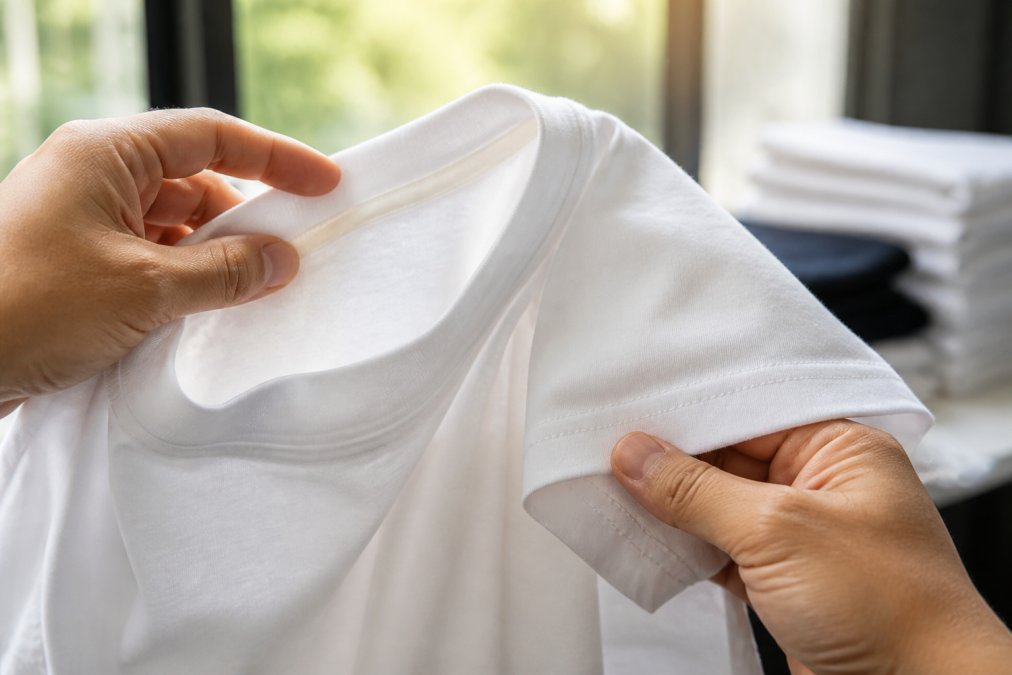
The neckline is where most cheap t-shirts fail first. A quality garment uses a seamless double-neck collar that holds its shape through repeated washing, rather than a single-fold collar that stretches out and develops that dreaded "bacon neck" look. Run your fingers along the inside of the collar, you should feel a smooth, continuous band with no rough edges.
Shoulder seam reinforcement is another marker of quality construction. Look for tape running across the shoulder seams on the inside of the garment, sometimes called neck tape. This stabilises the shoulder area and prevents the shirt from sagging or distorting under its own weight. Taped neck and shoulders are a feature you'll find on premium blanks, and their presence signals that the manufacturer invested in durability rather than cutting corners.
Sleeve and Hem Finishes
Check the sleeve openings and the bottom hem for the same double-needle treatment. The hem should lie flat when the shirt is on a hanger, with no puckering or waviness along the stitch line. Puckered hems indicate the fabric was fed unevenly through the sewing machine, which weakens the seam and looks sloppy when worn.
For fitted women's styles, inspect the side seams. A garment with side seams and a tapered fit offers a more tailored silhouette, but those seams must be finished cleanly to avoid irritation. Twin-needle finishing on the bottom hem and sleeves is the benchmark here, it creates a durable edge that won't roll or fray after washing.
How to Test Screen Print Durability and Print Quality
Screen print durability testing comes down to one question: will the design survive the washing machine? A properly cured screen print should feel smooth to the touch, almost like part of the fabric, rather than raised and plasticky. If the print feels thick and rubbery, it may have been applied too heavily or under-cured, which makes it prone to cracking and peeling.
The curing process is critical. Screen printing ink must reach the correct curing temperature during production to bond with the fabric fibres. When ink is under-cured, it sits on the surface rather than embedding into the cotton, and the first hot wash will start to break it down. A quality printer will cure the garment at the right temperature for the right duration, ensuring the print becomes part of the shirt itself.
Assessing Print Alignment and Edge Definition
Print alignment, or registration accuracy, refers to how precisely the design elements line up with each other and with the garment. On a quality tee, the design should sit centred between the collar and the hem, running parallel to the neckline. A crooked print is an instant sign of poor quality control, and it's one of the most common defects in budget custom apparel.
Edge definition matters just as much. Look closely at the boundaries of the print, they should be crisp and clean with no blurring, bleeding, or rough edges. On distressed or vintage-style prints, the worn effect is intentional, but it should look deliberate rather than like a printing error. If the design has fine text or intricate details, check that those elements are sharp and legible rather than muddy or filled in.
Testing Quality by Print Method: Screen, DTG, and DTF
Most quality guides stop at screen printing, but custom apparel today is produced with three main technologies, and each fails in different ways. Knowing what to test for each method will save you from approving a sample that looks great out of the bag but deteriorates after a few washes.
Screen printing is the benchmark for durability. The ink is forced through a mesh and cured directly into the fabric, creating a bond that survives 50 or more washes when done correctly. To test a screen print, flex the design sharply between your fingers. A quality cure will show no cracking or colour change. Then stretch the fabric beneath the print, if you see the ink lift or separate from the fibres, the cure was insufficient. Finally, rub the surface with a damp white cloth. If colour transfers, the ink was not fully cured and will bleed in the wash.
Direct-to-garment (DTG) printing uses water-based inks that soak into the fibres, giving a soft hand feel that many prefer over screen printing. However, DTG prints are more vulnerable to fading, especially on dark garments where a white underbase is required. To test a DTG print, look closely at the surface under bright light. A quality DTG print should show no visible dot pattern or banding, and the colour should be uniform across the design. Wash testing matters more here than with screen printing, so if you have a sample, run it through a cold wash and line dry before committing to a bulk order. A well-executed DTG print should survive 25 to 40 washes before noticeable fading begins.
Direct-to-film (DTF) transfers have gained popularity for small orders because they offer vibrant colours without the setup cost of screen printing. The trade-off is longevity. DTF prints sit on the surface of the fabric with a plastisol adhesive layer, which gives them a slightly raised feel and makes them more prone to cracking than screen printing. To test a DTF print, bend the garment at the design and look for hairline cracks. Then check the edges, a quality DTF transfer should have clean, well-adhered borders with no lifting or peeling. Most practitioners find that DTF prints last 20 to 30 washes before visible wear appears, so they are best suited to short-run orders or promotional items rather than long-term wardrobe staples.
The Wash Test Protocol
A single wash test tells you more than any visual inspection. Use this protocol on any sample before you approve a bulk order:
- Measure the garment dimensions and note the print condition.
- Wash in cold water (30°C or below) with a standard detergent, no fabric softener.
- Line dry or tumble dry on low heat.
- Inspect the print for cracking, peeling, or colour loss.
- Check the fabric for shrinkage beyond 3 to 5 percent.
- Repeat the cycle three times to accelerate the ageing process.
If the print survives three washes without visible degradation, it will likely hold up for the garment's expected lifespan. If you see cracking or fading after one wash, reject the batch and ask the supplier to re-examine their curing process.
Assessing Colour Opacity and Fabric Shrinkage
Colour opacity refers to how solidly the ink covers the fabric, and it's particularly important when printing light colours on dark garments. A quality print on a black tee should show no visible fabric texture through the ink, and the colour should appear vibrant and saturated rather than washed out. Hold the shirt up to the light, if you can see the fabric weave clearly through the printed area, the ink coverage is too thin.
Fabric shrinkage is a separate concern that comes down to the knit construction and pre-shrinking process. As noted earlier, pre-shrunk knit fabric has already undergone a treatment to minimise further shrinkage. However, even pre-shrunk cotton can shrink slightly with the first wash, which is why the best garments are cut with this in mind.
To test shrinkage yourself, measure the garment before and after a cold wash and line dry. A quality tee should not shrink more than 3 to 5 percent, roughly one size at most. If a shirt shrinks dramatically after one wash, the fabric was not properly pre-shrunk and the garment will continue to distort over time.
Custom Apparel Quality: Print Methods Compared
Custom apparel quality varies significantly depending on the printing method used, and understanding the differences helps you set realistic expectations. The three main methods for custom t-shirts are screen printing, direct-to-garment (DTG) digital printing, and heat transfer vinyl or DTF (direct-to-film).
| Print Method | Print Longevity | Best For | Limitations |
|---|---|---|---|
| Screen Printing | Excellent, 50+ washes | Bulk orders, bold designs | Higher setup cost per design |
| DTG Digital | Good, 25-40 washes | Full-colour photos, small batches | Can fade faster on dark fabric |
| DTF / Heat Transfer | Moderate, 20-30 washes | Small orders, complex colours | Thicker hand feel, prone to cracking |
Screen printing remains the gold standard for durability because the ink is forced through a mesh and cured directly into the fabric. It produces a vibrant, long-lasting print that survives repeated washing, which is why it's the preferred method for premium garments. DTG printing offers greater colour flexibility and is excellent for small runs, but the water-based inks can be less opaque on dark shirts and may fade more quickly. DTF transfers have improved in recent years but still sit a step below screen printing for longevity.
Check Custom Apparel Quality With a Pre-Production Sample
A pre-production sample is the single most reliable way to check custom apparel quality before committing to a full order. This is a physical prototype of your design printed on the actual garment you plan to order, allowing you to inspect fabric weight, print quality, and construction first-hand. Most reputable suppliers will offer a sample for an additional fee, which is typically credited toward your bulk order.
When reviewing your sample, put it through the same checks outlined in this guide: inspect the stitching, assess the print alignment and colour opacity, and measure the garment dimensions. Wash the sample at least once to see how the fabric and print hold up. This testing protocol takes a few days but saves you from discovering defects after you've paid for 50 shirts.
Ordering a sample also verifies that the supplier's quality control matches their marketing claims. A business confident in its production process will happily provide a sample, while one that hesitates may be hiding inconsistent output.
Common Defects in Custom Apparel and How to Spot Them
Even with a sample approved, defects can slip through in bulk production. Knowing what to look for during an inspection helps you catch problems before they reach your customers.
- Misaligned prints: The design is off-centre or tilted relative to the neckline. Check that the print sits parallel to the collar and centred between the seams.
- Cracking or peeling print: The ink shows hairline cracks or lifts away from the fabric, usually from under-curing or low-quality ink. Bend the fabric sharply, if the print cracks, it will fail quickly.
- Faded or washed-out colours: The print lacks vibrancy, often due to insufficient ink coverage or incorrect curing temperature. Compare against your approved sample.
- Loose or skipped stitches: Visible gaps in the seam stitching or threads that pull away easily. This indicates poor machine tension or low stitch density.
- Fabric puckering: The fabric bunches or waves along the seams, caused by uneven feeding during sewing. This weakens the seam and distorts the garment's fit.
- Excess shrinkage: The garment measures significantly smaller than the specified size chart after washing, indicating poor pre-shrinking.
- Neckline stretching: The collar loses its shape and becomes wavy or stretched after minimal wear, a sign of a weak single-fold collar.
For bulk orders, inspect a sample from each production batch rather than just the first one. Quality control can drift during a long production run, so spot-checking multiple units protects you from receiving a mix of good and defective garments.
Verifying Environmental and Ethical Certifications
Physical inspection only tells you how a garment looks and feels, not how it was made. If you are sourcing custom apparel for a brand, event, or corporate uniform, the production process matters as much as the finished product. Most quality guides skip this step entirely, but verifying certifications is the only way to confirm that your garments meet environmental and ethical standards.
OEKO-TEX Standard 100 is the most common certification for fabric safety. It tests for harmful substances across hundreds of parameters, including heavy metals, formaldehyde, and restricted azo dyes. A garment with this certification has been independently verified to be free from substances that could harm human health. Look for the certification number on the supplier's product page or request a copy of the certificate before ordering. A legitimate supplier will provide it without hesitation.
GOTS (Global Organic Textile Standard) certification goes further, covering the entire supply chain from raw fibre harvesting to finished garment. If you are buying organic cotton apparel, GOTS certification ensures that the organic claim is genuine and that social criteria are met during production. Be wary of suppliers who use the word "organic" without providing a GOTS certificate, as the term is often used loosely in marketing.
Ethical manufacturing certifications such as SA8000 or BSCI cover working conditions, fair wages, and labour rights. These are less common among small print-on-demand suppliers but are standard for larger apparel manufacturers. If your order is for a corporate client or a public-facing brand, asking about these certifications protects your reputation as well as your garments.
How to Request and Verify Certification Documents
When a supplier claims a certification, ask for the certificate number and the certifying body. You can then verify the claim directly on the certifier's database, which is publicly accessible for OEKO-TEX and GOTS. A supplier who cannot provide a certificate number or who becomes evasive when asked is likely making unsubstantiated claims.
For bulk orders, request that the certification details be included on the packing slip or in the delivery documentation. This gives you a paper trail that you can audit if questions arise later. It also signals to your supplier that you take quality and compliance seriously, which often results in better service and more consistent production.
Your Next Step for Quality Custom Apparel
Quality custom apparel comes down to the supplier's commitment to premium materials and careful production. When you find a business that specifies its fabric weight, uses double-needle stitching and taped necklines, and offers a return policy that backs its products, you've found a partner worth trusting.
At 123t Australia, every tee we produce is printed on 100% ring-spun cotton at 165gsm for men's styles and 150gsm for women's fitted cuts, with pre-shrunk knit, seamless double-neck collars, and double-needle hems. Our in-house designed novelty tees, like the Australian Consumer Law guidance on returns compliant range including the "Check Meowt Cat" and "000 Days Without Sarcasm" shirts, are built to survive repeated washing while keeping their humour intact. If a garment doesn't meet your expectations, our 60-day return policy has you covered.

Browse our funny novelty t-shirt collection and find a tee that makes you laugh today.
Frequently Asked Questions
How do I check the quality of a garment before purchasing?
Work through a garment quality checklist. Start with fabric weight, measured in GSM. For custom t-shirts, 150-165gsm ring-spun cotton offers a soft feel with enough structure for printing. Check the stitching: look for double-needle hems, a seamless double neck collar and taped neck and shoulders. Inspect the print for clean edges, even colour and no cracking in the design. If possible, order a pre-production sample to test washing and drying behaviour yourself.
Is 100% cotton or a cotton-poly blend better for custom prints?
For most custom t-shirts, 100% ring-spun cotton is the better choice. The tighter, smoother yarn gives a softer hand feel and a more even surface for screen printing, which helps colour opacity and print durability. Cotton-poly blends dry faster and resist wrinkles, but the poly fibres can make prints look less vibrant and may cause the fabric to pill over time. If you want a premium feel with reliable wash fastness, stick with 100% cotton.
Which is better, 220 or 240 GSM?
For a standard custom t-shirt, both are heavyweight options. 220 GSM is a solid mid-heavy fabric that drapes well and suits most screen printing. 240 GSM feels thicker and more substantial, which works well for hoodies or outerwear, but it can feel stiff for a regular t-shirt. For a balance of durability and comfort, 165-220 GSM is the sweet spot for most custom apparel. Choose 240 GSM only if you want a distinctly heavy, structured garment.
How do I know the print will not fade after a few washes?
Quality screen printing starts with proper curing during production, which sets the ink into the fabric. To test print durability, check the design's flexibility: a good print bends with the fabric without cracking. Look for a soft hand feel rather than a thick, plastic-like layer. Always wash custom apparel inside out in cold water and avoid tumble drying or ironing directly over the logo. These habits extend the life of any print significantly.

