


Table of Contents
- What Makes Custom T-Shirt Printing High Quality?
- Screen Printing vs Digital Printing: Which Method Delivers Better Quality?
- Best Fabric for Custom T-Shirts: GSM, Cotton Types and Durability
- Eco-Friendly Inks and Sustainability Certifications Explained
- Design Tools and Customisation Options for Perfect Prints
- T-Shirt Printing Turnaround Times and Shipping Expectations
- Pricing and Bulk Order Discounts: What Affects Your Quote
- Print Longevity Testing: How to Judge Washability and Durability
- Use-Case Specific Recommendations: Gifts, Events and Everyday Wear
- Frequently Asked Questions
Last Updated: September 18, 2026
What Makes Custom T-Shirt Printing High Quality?
High-quality custom t-shirt printing is the combination of three things: the right print method for your design, a garment that can carry it, and inks that survive repeated washing. Get one of those wrong and the shirt looks tired within a month.
The best quality custom t-shirt printing isn't about paying the most. It's about matching the technique to the job.
Three factors decide whether a print lasts:
- Print method matched to design complexity and order size
- Fabric weight and weave, which determine how ink bonds to the surface
- Ink type and curing, which control colour accuracy and washability
Most buyers only think about the first one. That's a mistake, and it's the reason so many personalised shirts disappoint.
Screen Printing vs Digital Printing: Which Method Delivers Better Quality?
Screen printing wins on durability and cost at volume. Digital printing wins on detail and small runs. Neither is universally "better", and any guide that tells you otherwise is selling you something.
Here's the practical breakdown.
How Screen Printing Works
Screen printing pushes thick ink through a mesh stencil, one colour at a time, then cures it with heat. The result is a bold, opaque print with excellent washability. It's the standard for team uniforms, event merch and anything ordered in bulk. Setup costs are higher because each colour needs its own screen, so it rewards larger runs.
How Digital Printing Works
Digital printing, including direct-to-garment, prints artwork straight onto the garment like a large inkjet printer. There's no setup cost, so it suits one-off designs, photo-realistic artwork and full-colour gradients. The trade-off is that print durability depends heavily on fabric choice and pre-treatment.
| Factor | Screen Printing | Digital Printing |
|---|---|---|
| Best for | Bulk orders, bold logos | One-offs, detailed art |
| Setup cost | Higher per colour | None |
| Colour accuracy | Excellent, spot colours | Excellent, CMYK range |
| Washability | Very high | High on treated cotton |
| Minimum order | Usually higher | Often none |
For most people ordering a funny birthday shirt for a mate, digital printing is often a sensible call. For a 200-shirt event run, screen printing can be cheaper per unit and tougher.
Best Fabric for Custom T-Shirts: GSM, Cotton Types and Durability
The best fabric for custom t-shirts is a 100% cotton or cotton-rich blend in the 180-220 GSM range for everyday wear. Heavier weights hold print better and resist shrinkage. Lighter weights feel cooler but can distort under thick ink.
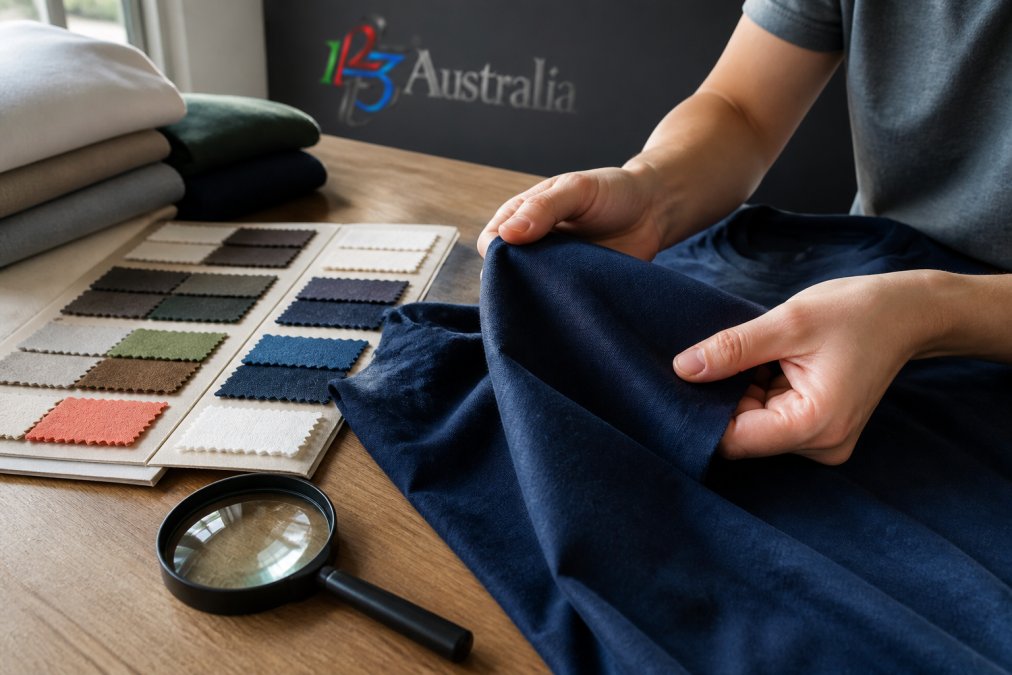
Fabric Weight and GSM Comparison
GSM stands for grams per square metre, and it's the single most useful number on a garment spec sheet.
| GSM Range | Feel | Best For | Print Behaviour |
|---|---|---|---|
| 140-160 | Light, thin | Warm climates, promo | Can distort under heavy ink |
| 170-190 | Standard | Everyday wear | Good all-round |
| 200-220 | Heavy cotton | Premium merch, gifts | Excellent ink hold |
| 240+ | Very heavy | Streetwear, workwear | Very durable, warmer |
A common mistake is chasing the highest GSM you can find. Past a point, heavier fabric just means a warmer shirt that takes longer to dry. For most gift and everyday use, 180-200 GSM is the sweet spot.
Eco-Friendly Inks and Sustainability Certifications Explained
Eco-friendly inks are water-based or plastisol-free formulations that release fewer volatile compounds during printing. They matter because they affect both the wearer and the people making the shirt.
Sustainability certifications are the part most buyers skip, and it's where greenwashing hides. Look for recognised textile and organic standards rather than vague "eco" claims on a product page. Genuine certification covers the whole supply chain, from fibre to finished garment, and is independently audited.
Water-based inks tend to sit softer on the fabric than plastisol, which many people prefer for everyday wear. The trade-off is that they can be less opaque on dark garments, so print quality depends more on the printer's skill.
If sustainability is a priority for you, ask what certification the garment carries, not just the ink. A certified organic cotton tee printed with standard inks is usually a better environmental outcome than an uncertified tee with "eco" ink.
Design Tools and Customisation Options for Perfect Prints
Good design tools remove the guesswork between what you see on screen and what arrives in the mail. A mockup generator that shows your artwork on the actual garment colour is worth more than a fancy editor.
What to look for:
- A mockup generator that renders your design on the real shirt colour
- Vector artwork support for logos and text
- High-resolution upload handling (300 DPI or better)
- Guidance on CMYK printing versus spot colours
- A design tool that warns you when artwork is too low-res
The most common file problem is a logo pulled from a website. Web images are low-resolution and print soft or pixelated. If you only have a small file, ask whether it can be redrawn as vector artwork before printing.
T-Shirt Printing Turnaround Times and Shipping Expectations
Standard turnaround for custom t-shirt printing typically involves a few business days for production, plus delivery time. Rush options may exist but usually carry a surcharge and depend on current workload. The key is to understand each stage so you can plan backwards from your deadline.
Plan around these stages:
- Artwork approval and proof, you review a digital mockup and confirm colours, placement and size. This can take a day or more if revisions are needed.
- Production and printing, screen printing setup plus run time, or digital printing queue. Usually 2-5 business days depending on order size and method.
- Curing and quality check, heat curing for screen prints, inspection for defects. Often same day as printing.
- Packing and dispatch, folding, bagging and labelling. Usually 1 business day.
- Delivery, depends on your location and chosen carrier.
Production Timeframes by Method
- Digital printing (including DTG): often 1-3 business days for small runs, because there's no screen setup. Good for last-minute gifts.
- Screen printing: typically 3-7 business days for standard runs, longer for multi-colour or large orders. The setup stage is the bottleneck.
- Vinyl and heat transfer: often 2-4 business days, depending on cutting and pressing time.
These are general guides, peak periods like Christmas, EOFY or event season can add several days. If you need something by a specific date, order earlier than feels necessary and confirm the production window before paying.
Shipping Within Australia
Most printers dispatch via Australia Post or a courier. Standard delivery is usually 2-5 business days for metro areas and 5-10 business days for regional and remote locations. Express post can cut that to 1-3 business days for metro, but it only speeds up the delivery leg, it doesn't shorten production time.
Australia Post delivery timeframes publishes current standard and express delivery windows, which is worth checking before you commit to a deadline.
The Unique Angle: Print Longevity Starts Before Delivery
Most guides stop at "when will it arrive". But the quality of your print is also affected by how it's packed and how you handle it on arrival. A print that's folded tightly against itself in transit can develop creases that look like cracks. When your order arrives:
- Unpack promptly and lay garments flat
- Check the print for any obvious defects before washing
- Follow the care instructions, cold wash, inside out, air dry
A personalised item isn't a stock item, so it can't be pulled off a shelf and shipped the same hour. Build in a buffer, especially for gifts. And if you're ordering for an event, confirm the dispatch date in writing so you're not caught short.
Pricing and Bulk Order Discounts: What Affects Your Quote
Pricing for custom t-shirt printing depends on quantity, garment choice, number of print colours and placement. There's no single "typical" figure, because a one-off digital print and a 500-unit screen print are different products entirely. You can build a realistic budget by understanding how each variable moves the number.
What moves your quote:
- Order quantity, bulk pricing lowers the per-unit cost, often in tiers (e.g. 10-24, 25-49, 50-99, 100+)
- Print colours, each extra screen colour adds a setup cost in screen printing, so a 4-colour logo costs more to set up than a 1-colour logo
- Garment quality, heavier cotton, ring-spun and certified organic fabrics cost more per unit
- Placements, front only versus front and back, plus sleeve prints, each add a print charge
- Turnaround, rush jobs usually carry a surcharge because they disrupt the production schedule
How Bulk Discounts Actually Work
Most printers use tiered pricing, where the per-unit price drops as quantity rises. The biggest jump is usually between a one-off digital print and a small screen-printed run, because screen printing spreads the setup cost across more units. Beyond a certain quantity, the savings per unit flatten out.
A practical tip: decide your quantity before you fall in love with a design. A small tweak to colour count can change the price. If your design uses multiple colours, ask whether it can be simplified without losing impact, that alone can cut setup costs significantly on a screen-printed run.
What to Ask Before You Pay
Australian Competition and Consumer Commission guidance on refunds and returns sets out your rights on faulty or misdescribed goods, which is worth knowing before any custom order. Custom-printed items are often exempt from change-of-mind returns, but they still must be of acceptable quality and match the description.
Print Longevity Testing: How to Judge Washability and Durability
Print durability comes down to ink type, curing and fabric. A properly cured print on quality cotton should hold its colour and shape through many washes.
You can test a print's washability before committing to a big order:
- Wash a sample inside out in cold water
- Skip the dryer and air-dry instead
- Check for cracking, fading or peeling after each wash
- Stretch the fabric gently to see if the ink flexes or splits
Shrinkage resistance matters too. Pre-shrunk and ring-spun cottons hold their size better than cheaper, loosely knit fabrics.
Use-Case Specific Recommendations: Gifts, Events and Everyday Wear
The right choice depends entirely on what the shirt is for. Here's how to match method to use case.
For gifts and one-off funny shirts: digital printing on a 180-200 GSM cotton tee. No minimums, full colour, fast to produce.
For events and team merch: screen printing on a heavier 200-220 GSM garment. Cheaper per unit at volume and tougher under repeated wear.
For everyday wear: a mid-weight, breathable fabric with a soft water-based print. Comfort beats boldness here.
For personalised clothing with names or dates: check the mockup carefully before approving, since personalised items usually can't be returned for a change of mind.
123t Australia designs its apparel and novelty gifts in-house. That's the difference between a print that looks sharp on day one and one that still looks sharp after a year of washes.
Frequently Asked Questions
What is the most durable method for custom t-shirt printing?
Screen printing is generally the most durable method for custom t-shirt printing. The ink is cured into the fabric, creating a bond that resists cracking and fading through many washes. Digital printing, including direct-to-garment, has improved significantly and works well for detailed designs, but screen printing still holds the edge for long-term washability and vibrant colour on heavy cotton. For the best results, choose a printer that uses quality inks and proper curing techniques.
How do I ensure high-quality results for custom apparel?
Start with high-resolution vector artwork or a 300 DPI PNG. Choose a fabric weight suited to the garment's use, such as 180-220 GSM for everyday t-shirts. Select a printing method that matches your design complexity and quantity. Always request a mockup or sample before bulk orders. Finally, follow the care instructions, washing inside out in cold water and avoiding direct ironing on the print, to maintain print quality and colour accuracy.
What fabric types are best for custom printed shirts?
100% cotton is the most popular for custom t-shirt printing because it takes ink well and feels comfortable. Ringspun cotton offers a softer feel and smoother print surface. Cotton-poly blends resist shrinkage and wrinkles, making them great for activewear. For breathable fabric and durability, look for 100% cotton at 180 GSM or higher. Heavy cotton (200+ GSM) provides a premium feel and excellent print longevity, especially for screen printing.
How long does custom t-shirt printing usually take?
Turnaround times vary by method and order size. Digital printing often ships within 2-5 business days, while screen printing may take 5-10 business days after artwork approval. Bulk orders can add a few days. Always confirm the timeline with your printer before ordering, especially for event deadlines. If you need rush service, ask about expedited options and cut-off times. Shipping time is additional and depends on your location and chosen carrier.
Getting custom apparel right comes down to matching the method, the fabric and the ink to what you actually need. 123t Australia offers in-house designed apparel and personalised custom clothing, high-quality materials, free shipping and a 60-day return policy, backed by a 5.0 customer rating. Whether you want a funny birthday shirt, a personalised gift or event merch, get started with 123t Australia and order a print that lasts.

