


Table of Contents
- Why Choose a Threadheads Alternative for Custom Apparel
- What to Compare When Evaluating Custom T-Shirts
- Funny T-Shirts: Ready-Made vs Custom Design
- Personalised Apparel: Upload Your Own Artwork
- Custom Hoodies: Sizing, Fit, and Print Methods
- Pricing, Shipping, and Turnaround Times
- Returns, Guarantees, and Customer Support
- Common Mistakes When Ordering Custom Apparel
- How to Choose the Right Custom Apparel Provider
- Frequently Asked Questions
Last Updated: October 17, 2026
Why Choose a Threadheads Alternative for Custom Apparel
Finding the right custom apparel provider can feel overwhelming when you want quality, reliability, and value, whether it's a funny T-shirt for a mate's birthday, personalised hoodies for a work team, or designs that reflect your personality. A Threadheads alternative for custom apparel gives you options beyond one provider, each with different strengths in print quality, fabric, design flexibility, and pricing.
At 123t Australia, we know what matters when comparing custom apparel services: whether the print lasts through repeated washes, if the fabric feels premium, how much customisation you get, and whether delivery arrives on time. This guide breaks down what to look for and the pitfalls that catch people off guard.
Not every provider works the same way. Some specialise in upload-your-own designs, others in ready-made graphic tees; some offer rush turnaround, others don't. Understanding these differences before you order saves frustration and money.
What to Compare When Evaluating Custom T-Shirts
Several factors separate a good custom apparel experience from a disappointing one. Start with the fundamentals: print quality, fabric stock, customisation options, and how the provider handles your artwork, each directly affects whether the finished product looks as good as you imagined.
Print quality and durability
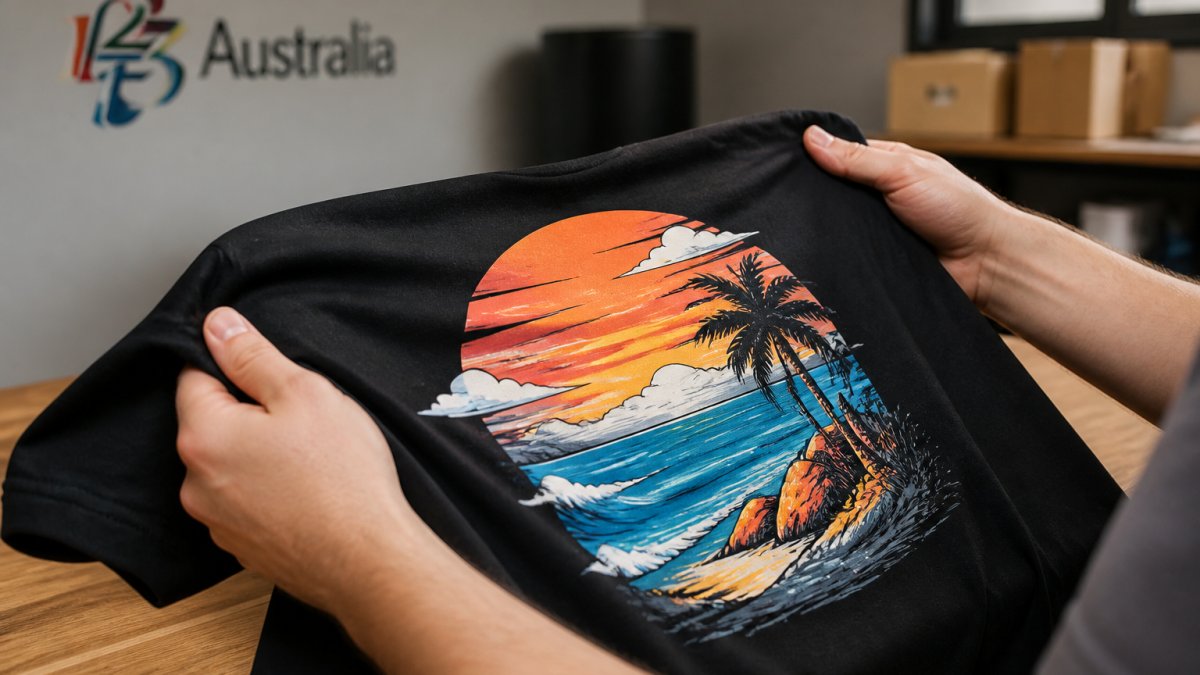
Print quality determines whether your design looks sharp on day one and stays vibrant after ten washes; poor print work fades, cracks, or peels. Look for providers who specify their method, screen printing, direct-to-garment (DTG), or sublimation each suit different designs. Durability matters just as much: premium providers test against repeated washing.
Fabric quality and shirt stock
The fabric underneath your design makes or breaks the final product, a brilliant print on thin, scratchy cotton feels cheap. Quality providers offer combed cotton or premium blends; combed cotton removes short fibres for softer, more durable fabric. Weight matters too: heavier fabric feels substantial and wears better. For personalised apparel you'll wear regularly, better fabric is worth the investment.
Customisation options and design upload
How flexible is the provider with your artwork? Can you upload your own design freely, or are you limited to templates? Which file formats do they accept, and what's their revision policy before printing? Some providers specialise in made-to-order uploads, others in fixed ready-made designs. A Threadheads alternative for custom apparel should offer clear upload processes and support for common file types (PNG, PDF, AI, EPS), and preview your design on the actual garment before printing to catch errors early. Design requirements vary too, minimum order quantities, single-item printing, design fees, so understand the limits upfront.
Funny T-Shirts: Ready-Made vs Custom Design
The choice between ready-made graphic tees and custom designs depends on what you're after. Ready-made tees are already created and tested: browse, choose, order, no design work required, ideal if you find a design you love and want it quickly, though selection is limited to what the provider has produced. Custom designs give you complete control: a funny T-shirt with an inside joke, your mate's face, or a design that doesn't exist anywhere else, uploaded yourself or built with the provider's design team. The downside is longer turnaround and potentially higher costs, especially for single orders. For gifts, custom designs often feel more thoughtful; for casual wear, ready-made may be all you need. Many providers offer both.
Personalised Apparel: Upload Your Own Artwork
Uploading your own artwork gives you complete creative control, where custom apparel really shines for personalised gifts and unique designs. The process is straightforward: prepare your artwork, upload it, preview it on the garment, approve, and order. Quality depends partly on your artwork and partly on the provider's printing capability. Prepare your file properly: high-resolution, colours as specified, within file size limits, and in the exact dimensions requested for the print area. Many providers offer design assistance, if you're unsure about formats or sizing, ask. Good providers respond quickly, a sign of customer-focused service.
Custom Hoodies: Sizing, Fit, and Print Methods
Custom hoodies are popular for teams, gifts, and personal wear, but fit and print placement matter more than with T-shirts. Sizing consistency varies: some providers use standard Australian sizing, others run small or large. Check the size chart carefully, better providers list detailed measurements (chest width, sleeve length, body length) so you can compare against hoodies you own. Print placement differs too: front chest prints are standard, but back and sleeve prints are options, so confirm print area dimensions and placement before uploading. Fabric quality matters significantly, fleece weight, cotton blend, and construction affect comfort and longevity.
Pricing, Shipping, and Turnaround Times
Cost is the factor most likely to surprise you at checkout, because custom apparel pricing is a stack of setup, per-unit, print, fabric, and delivery charges. The only way to fairly compare a Threadheads alternative for custom apparel is to calculate the total landed cost for your exact order, not the headline per-shirt price.
What actually drives the price
Every quote is built from the same components. Understanding them shows where a provider is cheaper and where it's quietly more expensive.
- Setup and screen fees. Screen printing carries a one-off setup cost per colour per design. This is why a single screen-printed tee can cost more than a DTG-printed one, even though the per-unit print cost is lower at volume.
- Per-unit print cost. Direct-to-garment (DTG) has no setup fee but a higher per-unit cost, so it suits one-off and small runs. Screen printing becomes cheaper per unit once you pass roughly 20-30 units per design.
- Garment cost. A standard 180 gsm cotton tee and a 220 gsm combed-cotton tee can differ by $8-$15 per unit at retail. Hoodies sit well above tees because of fleece weight and construction.
- Artwork and design fees. Some providers charge a file-prep or vectorisation fee (commonly $15-$50) if your artwork is not print-ready. Others absorb it.
- Delivery. Domestic standard shipping for a small apparel order typically falls in the $8-$15 range; express post is usually $15-$25. Free-shipping thresholds, where offered, commonly sit around $100-$150.
Indicative price bands (AUD, October 2026)
The table below shows typical Australian market ranges for common order types. Treat these as planning bands, not quotes, always confirm with the provider's live calculator, because fabric choice and print method move the number significantly.
| Order type | Typical unit price (AUD) | Typical total incl. standard shipping (AUD) | Notes |
|---|---|---|---|
| Single custom tee (DTG, upload your own) | $35-$55 | $45-$70 | No setup fee; artwork must be print-ready |
| Single custom hoodie (DTG) | $65-$95 | $75-$110 | Fleece weight drives the spread |
| 10 tees, one-colour screen print | $25-$35 | $270-$370 | One setup fee spread across 10 units |
| 25 tees, one-colour screen print | $18-$28 | $470-$720 | Setup cost now marginal per unit |
| 50 tees, two-colour screen print | $16-$24 | $820-$1,220 | Two setup fees; best per-unit value |
| 10 hoodies, one-colour print | $55-$75 | $570-$770 | Heavier garment, higher freight |
Two patterns stand out: the per-unit price falls sharply between 1 and 25 units, then flattens (ordering 50 instead of 25 rarely halves it), and shipping is a fixed-ish cost that hurts small orders proportionally more, which is why a single tee can cost almost as much in freight as in printing.
Turnaround times
Standard production for custom apparel in Australia typically runs 5-10 business days from artwork approval, plus 1-3 business days for delivery. The clock starts at artwork approval, not order placement, if your file needs correction, you lose days, so build that into your timeline for dated events.
Calculating your total order cost
Use this sequence to compare providers on equal terms:
- Confirm the garment and weight you want, and get the per-unit price at your exact quantity.
- Add any setup, screen, or artwork fees.
- Add shipping to your postcode for the full order weight.
- Add any rush surcharge if you have a deadline.
- Divide the total by the number of units to get your true landed cost per item.
A provider with a lower per-shirt price but a setup fee and shipping can easily lose to one with a slightly higher unit price and free delivery on an order.
Australia Post domestic parcel delivery times
Returns, Guarantees, and Customer Support
Custom apparel sits in an awkward spot for returns: the item is personalised, so a provider cannot resell it, yet the customer has often spent $50-$300 on something they cannot inspect before it arrives. Returns policies for custom orders are therefore narrower than for off-the-shelf clothing, and the fine print matters far more than the headline "30-day returns" badge.
What Australian consumer law actually guarantees
Regardless of a provider's own policy, custom apparel sold to consumers in Australia is covered by the consumer guarantees in the Australian Consumer Law (ACL), administered by the ACCC. The key guarantees are that goods are of acceptable quality, fit for their described purpose, and match the sample or description. If a custom tee arrives with a print defect, garment fault, or a design materially different from what you approved, those guarantees apply, with a remedy of repair, replacement, or refund depending on the seriousness of the failure. The nuance for custom orders: the ACL does not require a refund simply because you changed your mind or a personalised item doesn't suit, but it does require a remedy if the item is faulty, misdescribed, or not fit for purpose.
The four failure types and the remedy you should expect
Most custom-order disputes fall into four categories. Knowing which one you have tells you what to ask for.
| Failure | Example | Typical remedy |
|---|---|---|
| Print defect | Cracking, peeling, misaligned or faded print on arrival | Reprint or refund, a major failure under the ACL |
| Garment fault | Hole, broken zip, seam failure on a hoodie | Repair, replacement, or refund |
| Wrong item or design | Different design, colour, or garment to what was approved | Replacement or refund |
| Sizing mismatch | Garment measures differently to the provider's own size chart | Exchange or refund if the chart was inaccurate; not covered if you ordered the wrong size against an accurate chart |
The sizing row is where most disputes land. If the provider's size chart was accurate and you chose the wrong size, that is generally on you, which is why checking measurements against a garment you own before ordering is the single best protection. If the chart was wrong, the ACL applies.
What a strong custom-order policy looks like
When comparing providers, look for these specific commitments rather than vague reassurance:
- A stated window for reporting faults, commonly 14-30 days from delivery, with a clear process (photos, order number, description).
- A reprint-first remedy for print defects, since a reprint is usually faster and fairer than a refund for a personalised item.
- A written statement that ACL guarantees apply and are not excluded by the custom-order policy.
- A size-exchange option for non-personalised items, even if personalised items are excluded.
- Named contact channels, email and phone, rather than a web form only.
A provider who publishes these specifics has handled custom-order problems before and has a process; one-line boilerplate is a risk.
Guarantees on print longevity
Print-durability guarantees are less common than you'd expect. The practical protection is the ACL's acceptable-quality guarantee: a print that fails after a handful of normal washes is very unlikely to be of acceptable quality, regardless of the marketing.
Customer support: what to test before you order
The cheapest way to assess support is to ask a pre-sale question and time the response. Send a specific query, file format, print placement, size chart for a particular garment, and see whether the answer is specific or generic. A provider who answers precisely before you pay is far more likely to resolve a problem after you pay. Check reviews for how complaints were handled, not just whether they occurred: every provider has some faulty orders, and the differentiator is whether customers report a fast reprint or weeks-long silence. Look for patterns around "replaced," "refunded," and "responded quickly" versus "no reply" and "had to chase."
ACCC consumer guarantees for goods and services
Common Mistakes When Ordering Custom Apparel
Learning from others' mistakes saves time and money. These are the most common errors when ordering custom apparel.
Uploading low-resolution artwork is mistake #1: you design something beautiful at screen resolution and get a blurry, pixelated print. Always work at 300 DPI minimum, and ask the provider if you're unsure about your file.
Ignoring sizing charts catches people constantly, every provider's sizing differs slightly, so spend two minutes comparing their measurements to a garment you already own.
Not previewing before approving is another common slip. Many providers show a digital preview on the actual garment; check colour accuracy, print placement, and overall appearance, as this is your last chance to catch errors.
Ordering without checking turnaround times leads to panic when a gift doesn't arrive in time. Confirm delivery dates before ordering, especially during busy seasons like Christmas, and ask about rush options and their actual cost.
Choosing the cheapest option without checking quality often backfires: a custom T-shirt at half the normal price might use thin fabric, poor printing, or both. Quality and price correlate for a reason.
Not reading the returns policy leaves you stuck if something goes wrong. Know whether you can return custom items, how long you have, and what qualifies for a refund, some providers won't accept returns on custom orders, a significant risk.
How to Choose the Right Custom Apparel Provider
Choosing between providers comes down to matching their strengths to your needs, not every provider is best for every order. Start by clarifying what matters most: Is speed critical? Are you uploading custom artwork or choosing ready-made designs? Bulk quantities or a single item? Fabric quality or price? Then evaluate providers against those criteria. If you need fast turnaround, rule out providers with 14-day standard delivery; if uploading artwork, choose strong design support and clear file requirements; if fabric quality matters, compare specifications and read reviews about durability. Check reviews for the type of order you're making, bulk team-order reviews might not reflect single custom pieces, and look for patterns: multiple mentions of faded prints, sizing problems, or poor support are warning signs. Compare what each provider includes, since design fees and shipping charges vary, and understanding the full cost upfront prevents checkout surprises.
123t Australia specialises in in-house designed apparel with unique, humorous, and personalised options. If you're after distinctive designs backed by quality materials and reliable customer support, this is worth exploring. The 60-day return policy gives you genuine peace of mind.
Ordering custom apparel should feel straightforward, not risky. The difference between a great experience and a frustrating one comes down to choosing the right provider and knowing what to expect before you order. A Threadheads alternative for custom apparel gives you genuine options, each with different strengths in print quality, customisation, pricing, and service. Evaluate providers against your specific needs, check their quality and returns policies, and ask questions before ordering. Get it right, and custom apparel becomes a reliable way to find unique gifts or express your personality through clothing that actually lasts.
Frequently Asked Questions
What are the best alternatives to Threadheads for custom apparel?
The best alternative depends on your priorities: design flexibility (upload-your-own vs ready-made), and delivery speed. Look for providers offering in-house printing, premium fabric stock, and transparent turnaround times. Check customer reviews for print durability after washing, and compare total costs including shipping.
Can I personalise a T-shirt with my own design, and what file types do I need?
Yes, most custom apparel providers accept artwork uploads. Standard formats include PNG and PDF. High-resolution files ensure crisp print quality. Check upload requirements, file size limits, and whether the provider offers design feedback or revisions. Ask about placement options: front, back, or sleeves affect pricing and turnaround.
How do I know if a custom apparel provider is trustworthy?
Look for customer reviews mentioning print quality, durability after multiple washes, and accurate sizing. Check the return policy: legitimate providers offer 60 days for returns or exchanges. Verify they have clear contact details and responsive customer support. Ask for examples of previous orders. Avoid providers with vague turnaround times or hidden fees.
What's the difference between screen printing and direct-to-garment printing for custom apparel?
Screen printing works best for solid colours and bold designs; it's durable and cost-effective for bulk orders but requires separate screens per colour. Direct-to-garment (DTG) printing handles complex, multi-colour designs and photographic images on individual garments without setup fees. DTG typically costs more per unit but offers faster turnaround for small orders. Screen printing produces slightly thicker ink that may crack with time; DTG integrates ink into fabric for softer feel and better longevity with proper care.

