


Table of Contents
- How the Return Policy for Custom Apparel Actually Works
- Australian Consumer Law Refunds for Custom Goods
- Change of Mind Policy for Personalised Items
- How to Report Faulty Custom Apparel
- Faulty Goods vs Change of Mind: The Logic That Decides Your Refund
- Return Eligibility, Timeframes and Condition Requirements
- Non-Refundable Items and Return Shipping Costs
- How 123t Australia Handles Custom Apparel Returns
- Sustainability and Waste Reduction in Custom Apparel Returns
- Conclusion
- Frequently Asked Questions
Last Updated: September 17, 2026
How the Return Policy for Custom Apparel Actually Works
A return policy for custom apparel exists because personalised items are made for one person and cannot be resold to another. That single fact shapes every rule that follows, from what you can send back to who pays the postage. At 123t Australia, we've handled enough returns to know that most frustration comes from customers expecting a standard retail refund on a garment printed with their mate's nickname on it.
Here's the good news: the law still protects you when something is genuinely wrong, and a fair policy covers far more than most people expect.
Below, we break down exactly how a return policy for custom apparel works in practice, what your rights are when a print is faulty, and how to tell the difference between a change of mind and a defect. We'll also show you the step-by-step workflow for lodging a claim, plus what most policy pages never explain: why personalised goods are treated differently in the first place.
ACCC guide to consumer guarantees
Why Personalised Items Sit in a Different Category
Standard retail returns assume the item can go back on the shelf. A custom-printed hoodie with "World's Okayest Dad" on the chest cannot. Once it's printed, it has no resale value to anyone but the person who ordered it.
That's the entire logic behind the category. Personalisation makes a product bespoke, and bespoke products sit outside the usual change-of-mind framework. This isn't a loophole retailers invented; it reflects a genuine commercial reality. A business that refunds every change-of-mind custom order would absorb the full cost of a garment nobody else can buy.
What that means for you as a buyer is simple: check your sizing, spelling, and design proof before you confirm the order. After that point, the return policy for custom apparel shifts from "I changed my mind" to "something went wrong in production."
Australian Consumer Law Refunds for Custom Goods
Australian Consumer Law refunds for custom goods still apply, and no personalised product sits outside them. The consumer guarantees are automatic, they cannot be excluded by any store policy, and they cover custom-made items exactly as they cover off-the-shelf ones.
If a custom garment arrives with a defect, doesn't match what you ordered, or isn't fit for purpose, you're entitled to a remedy. That's a legal right, not a favour from the retailer.
Your Consumer Guarantees in Plain English
The ACCC's consumer guarantees overview sets out what you're owed. In plain terms, your custom apparel must be:
- Of acceptable quality - safe, durable, and free from defects
- Fit for the purpose you told the seller about
- Match the description shown in the proof or listing
- Match the sample or demonstration you were shown
If any of these fail, you choose the remedy. A major failure means you can pick a refund or replacement. A minor failure means the seller can choose to repair, replace, or refund.
Change of Mind Policy for Personalised Items
A change of mind policy for personalised items is where retailers have real discretion. Because the item can't be resold, most custom apparel sellers don't accept change-of-mind returns, and that's generally lawful.
That said, "generally" hides a lot of nuance. Some businesses offer store credit for unworn items. Others accept size exchanges if the garment is still in original condition. The key phrase in almost every policy is original condition: unworn, unwashed, tags attached, no noticeable wear.
If you've worn the shirt to a party and now want a refund, no policy will help you. If you tried it on once, decided the fit was wrong, and it's still pristine, you have a much better shot, especially with retailers who offer store credit as a goodwill gesture.
Sizing Mistakes, Makeup Stains and Other Common Scenarios
Sizing mistakes are the single most common reason people try to return custom apparel. Unfortunately, they're also the hardest to resolve, because the garment was printed to a size you selected.
Makeup stains, deodorant marks, and food spills are the other frequent culprits. Once a garment shows noticeable wear or staining, it fails the original condition test and most policies will decline it.
Here's how the common scenarios usually play out:
| Scenario | Likely Outcome | Why |
|---|---|---|
| Wrong size ordered | Store credit or exchange, if unworn | Change of mind, item is resellable only as blank stock |
| Defective print | Refund or replacement | Consumer guarantee breach |
| Makeup or food stains | Declined | Fails original condition |
| Item not as described | Refund or replacement | Consumer guarantee breach |
| Damaged in transit | Refund or replacement | Faulty goods |
| Ordered wrong design | Store credit, if unworn | Change of mind |
How to Report Faulty Custom Apparel
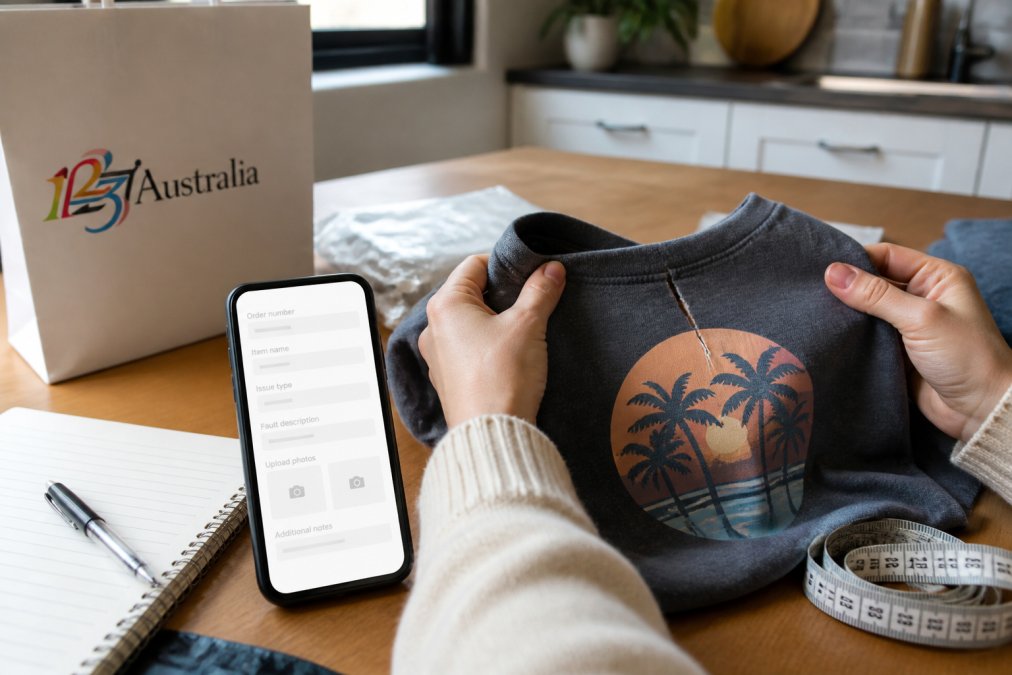
Reporting faulty custom apparel works best when you document the problem clearly and contact the seller promptly. Most retailers ask for photos within a set window, often 7 to 14 days from delivery, so don't sit on it. The longer you wait, the harder it becomes to argue the fault was present when the parcel arrived rather than caused by wear.
Step-by-Step Return Workflow
Most policy pages stop at "contact us within 14 days." That leaves you guessing about what to photograph, how to pack a printed garment so the fault isn't blamed on transit, and which postal service actually protects you if the parcel disappears. Here is the workflow that resolves claims fastest, written for the person holding the garment rather than the person writing the policy.
Step 1, Photograph the fault properly. Take three shots: a close-up of the defect itself, a mid-shot showing where on the garment it sits, and a full flat-lay of the whole item. Include a ruler or a coin next to the fault for scale if it's a print misalignment or a cracked screen-print. Daylight beats indoor lighting every time.
Step 2, Locate your proof of purchase. An order confirmation email, tax invoice, or bank statement showing the transaction all work. If the order was a gift, ask the buyer to forward the confirmation, most sellers will accept a forwarded email as proof.
Step 3, Check the delivery date, not the order date. Return windows run from the day the parcel was delivered, which is the date on the tracking scan. If you signed for it, that's your start date. Screenshot the tracking page before it expires from the carrier's system.
Step 4, Contact the seller in writing. Use email or the website's contact form rather than a phone call, so you have a dated record. State the order number, the fault, and what remedy you're seeking (refund or replacement). Attach your photos in the first message, it saves a round trip.
Step 5, Request a return authorisation (RA) number. Many retailers won't accept a parcel without one, and some will refuse delivery at the warehouse. Get the RA number and the return address in writing before you post anything.
Step 6, Pack it to survive transit. Fold the garment flat, place it inside a satchel or box so the printed area isn't creased against a hard edge, and include a printed copy of the RA email. Don't send it back in the original poly mailer if that mailer is torn, a damaged parcel can be blamed on you.
Step 7, Post it back using the method the seller specifies. If the seller is covering return postage, they'll usually issue a prepaid label or a reply-paid address. If you're paying, use a tracked service, Australia Post Parcel Post with tracking, or a courier with signature on delivery. Keep the tracking receipt and a photo of the lodged parcel until the refund clears.
Step 8, Wait for assessment, then follow up. A reasonable assessment window is 5 to 10 business days from the seller receiving the item. If you haven't heard back by then, reply to your original email thread with the tracking number and a polite nudge. Keep the whole thread, it's your evidence if the matter escalates.
What Counts as Evidence of a Fault
Not every complaint needs the same proof. A cracked or peeling print, a misaligned logo, or a garment that arrived with a seam already splitting are usually accepted on photos alone. A colour mismatch is harder, you'll need the approved digital proof alongside the delivered item, because screens vary and the seller will argue the proof matched. A sizing fault (the garment measures differently from the size chart) needs a tape measure in the photo, laid flat across the chest and length.
If the fault only appears after washing, check the care label first. Print failures caused by washing at the wrong temperature or tumble drying are generally treated as wear rather than a manufacturing defect, and most policies exclude them. If you followed the care label and the print still lifted, that's a stronger claim, keep the care label intact and photograph it alongside the fault.
If the Seller Won't Respond
If a seller ignores a genuine faulty-goods claim, you're not without options. Consumer affairs agencies in each state and territory run free complaint services, and the ACCC publishes guidance on how to escalate a consumer guarantee dispute. The practical sequence is: written reminder to the seller, then a formal complaint to your state or territory consumer affairs body, then, for larger amounts, a tribunal claim. Keep every email and photo; the paper trail is what moves a stalled claim forward.
Faulty Goods vs Change of Mind: The Logic That Decides Your Refund
The distinction between faulty goods and a change of mind decides your refund, and it comes down to one question: was the product made correctly and described accurately? If yes, and you simply don't want it, that's a change of mind. If no, it's a consumer guarantee issue and the seller must remedy it.
This is the part most policy pages get wrong. They lump everything into a single "returns not accepted" line, which is both unhelpful and, for faulty goods, legally incorrect.
Faulty goods include a defective print, a misaligned design, a garment that tears at the seam within a reasonable time, or an item that arrives soiled or damaged in transit. Change of mind covers ordering the wrong size, deciding you don't like the colour, or picking the wrong design.
The remedy you're entitled to also differs. For faulty goods, you choose between a refund and a replacement. For a change of mind, the seller chooses whether to offer anything at all, and many offer store credit as a middle ground.
Return Eligibility, Timeframes and Condition Requirements
Return eligibility for custom apparel usually hinges on three things: how long you've had the item, what condition it's in, and whether you have proof of purchase. Get all three right and most claims proceed smoothly. Get one wrong and you'll be arguing about the wrong thing instead of the fault itself.
What Starts the Clock
The return window runs from the date of delivery, not the date you placed the order. That matters for custom apparel because production and shipping can add one to three weeks between order and arrival. If your policy says "14 days" and you count from the order date, you may have almost no window left by the time the parcel lands.
For faulty goods, the window is effectively longer than any stated policy period, because the consumer guarantees don't expire on a fixed date. A print that peels after three washes, or a seam that fails within a reasonable time, can still be a consumer guarantee issue even if the retailer's stated return window has closed. What counts as "reasonable" depends on the item, a novelty tee worn weekly is judged differently from a hoodie worn daily for a year.
Timeframes in Practice
A 60-day window from delivery is common for faulty goods in the custom apparel space, while change-of-mind windows tend to be shorter, often 14 to 30 days. Some sellers split the difference: 30 days for a size exchange, 14 days for a refund on unworn stock. Check the specific policy before you assume you're within the limit, and screenshot the policy page at the time of purchase, policies change, and the version that applied when you bought is the one that governs your claim.
Condition Requirements, Assessed Honestly
Condition requirements are stricter for change-of-mind returns than for faulty ones. For a change of mind, the item must be unworn, unwashed, and free from makeup stains, deodorant marks, perfume, pet hair, or noticeable wear. Tags should still be attached where the item came with them. Trying a garment on once over your own clothes is fine; wearing it to an event is not.
For faulty goods, the assessment focuses on the fault itself, not on whether the item is pristine. A defective print on a garment you've worn twice is still a defective print. That said, sellers may reasonably ask that the item be returned in a state that lets them inspect the fault, so don't cut the garment up or throw away the packaging before the claim is resolved.
A practical test most sellers apply: would this item be resellable as blank stock if the print were removed? If yes, a change-of-mind return is plausible. If no, because it's stained, stretched, or smells of perfume, the change-of-mind route is closed, and only a genuine fault will get you a remedy.
Proof of Purchase in Edge Cases
Proof of purchase matters in every case, and it doesn't have to be a formal tax invoice. An order confirmation email, a bank or card statement showing the transaction, a PayPal or Afterpay receipt, or a screenshot of the order in your account all typically work. If the item was a gift and you don't have the receipt, ask the buyer to forward the confirmation email, most sellers accept a forwarded email as proof. If you bought through a marketplace, the marketplace's order record is usually sufficient.
What won't work is a verbal claim with no record. If you can't show the transaction, the seller has no way to verify the item came from them, and the claim stalls before it starts.
Non-Refundable Items and Return Shipping Costs
Non-refundable items in custom apparel usually include anything personalised with a name, date, or custom design, plus clearance stock and gift cards. These exclusions exist because the item has no resale value once printed.
Return shipping costs depend on why you're returning. For faulty goods, the seller is generally responsible for the cost of return postage, because the fault is theirs. For change of mind, you'll usually pay the return postage yourself, and some retailers charge a restocking fee if they accept the return at all.
International return logistics add another layer. If you've ordered from overseas, return postage can cost more than the garment itself, and customs paperwork may apply. For low-value items, a replacement is often the more practical remedy than a return.
How 123t Australia Handles Custom Apparel Returns
123t Australia takes a straightforward approach: a 60-day return policy, backed by the consumer guarantees that apply to every Australian purchase. If a custom tee, hoodie, mug, or stubby holder arrives with a print defect or doesn't match the design you approved, we'll sort it out with a refund or replacement.
For change-of-mind returns on unworn items, we'll work with you on a fair outcome, because a family-run business lives or dies on how it treats people after the sale, not just before it.
The best way to avoid a return entirely is to check your size and spelling before you order.
Sustainability and Waste Reduction in Custom Apparel Returns
Sustainability and waste reduction matter more in custom apparel than in almost any other retail category. Every personalised item that gets returned and can't be resold is a garment, a print, and the energy that went into both, headed for waste.
Conclusion
The hardest part of a return policy for custom apparel is balancing genuine consumer protection with the reality that personalised goods can't be resold. Get that balance right and you build trust; get it wrong and you lose customers who feel trapped by fine print.
Frequently Asked Questions
Can I return custom items if I simply change my mind?
Under a change of mind policy for personalised items, most custom apparel retailers will not accept returns because each item is made specifically for you and cannot be resold. That said, some businesses offer store credit or exchanges at their discretion. Always check the return policy for custom apparel before ordering, and confirm whether a restocking fee applies. If the item is faulty, different rules apply.
Are custom-made items exempt from Australian Consumer Law refunds?
No. Australian Consumer Law refunds for custom goods still apply when an item is faulty, significantly different from the description, or unfit for purpose. Personalised products are not automatically exempt from consumer guarantees. If a custom t-shirt arrives with a defective print, damaged seams, or the wrong design, you are entitled to a remedy such as a refund, replacement, or repair.
What are my rights if custom apparel is faulty or damaged?
If your custom apparel arrives with a defective print, faulty stitching, or noticeable damage, you have the right to a remedy under consumer guarantees. Contact the retailer with your proof of purchase and photos of the fault. They may offer a refund, replacement, or repair. For major failures, you can choose a refund or replacement. Return shipping costs for faulty goods are typically covered by the retailer.
How long do I have to return faulty custom apparel?
There is no fixed deadline under Australian Consumer Law for faulty goods, but you should report the issue as soon as you notice it. Many retailers, including 123t Australia, offer a 60-day return window for faulty items. For change of mind, timeframes vary and are set by the retailer's own policy. Always check the specific return policy for custom apparel before you buy.

