

Last Updated: October 24, 2026
Quick Summary
A personalised t-shirt is a garment printed with a design, photo or line of text chosen specifically for one person, which is why it lands better than a generic present. It gets a laugh, then gets worn, because the effort behind it says you thought about them.
- A single custom printed t-shirt at 123t Australia starts at $35.75, covering garment, print and personalisation.
- Aim for 300 DPI at final print size and save artwork as PNG or PDF with a transparent background.
- For a one-off funny gift shirt, DTF or digital printing usually makes the most sense.
- Measure a shirt they already own flat, chest armpit to armpit, and compare it to the size chart.
- Wash inside out in cold water and skip the tumble dryer to keep the print from cracking.
Table of Contents
- Why a Personalised T-Shirt Beats Another Boring Gift
- Choosing the Garment: Style, Fit and Fabric
- Getting Colours and Sizes Right the First Time
- How to Design Your Own T-Shirt: Artwork Step by Step
- Custom Printed T-Shirts: Choosing the Right Print Method
- Print Placement, Print Area and What Survives a Wash
- Personalised T-Shirt Gifts for Birthdays, Teams and Baby Showers
- What a Personalised T-Shirt Costs: A Real Breakdown
- Caring for Your Shirt So the Print Lasts
- Pick Your Design and Order Your Shirt
- Frequently Asked Questions
Why a Personalised T-Shirt Beats Another Boring Gift
A personalised t-shirt is a garment printed with a design, photo or line of text chosen specifically for one person, which is why it lands better than a generic present. At 123t Australia, we have watched blokes unwrap socks, smell Lynx gift sets and force a smile at another voucher. The personalised t-shirt gets a laugh, then gets worn. For inspiration, browse these funny t-shirt ideas. That is the whole trick: it is funny, it is theirs, and it does not end up in a drawer.
The reason it works comes down to effort. A novelty gift says "I grabbed something at the servo." A custom printed t-shirt with their name, their in-joke or a ridiculous slogan says "I thought about you." That difference is worth more than the price tag.
Choosing the Garment: Style, Fit and Fabric
Start with the shirt itself, because a brilliant design on a scratchy, boxy tee still disappoints. The garment decides how often it gets worn, and that decides whether your gift was a hit.
Most people default to a classic crew neck in a standard fit, and that is usually right for a funny novelty tee. It suits nearly everyone and prints cleanly across the chest.
Fabric matters more than most shoppers realise. Cotton breathes, takes print well and feels soft against skin. Look for ring-spun cotton, which is spun finer and feels noticeably smoother than standard cotton.
Cotton Quality and What 165gsm Actually Means
GSM stands for grams per square metre, and it measures how heavy and dense the fabric is. A 165gsm cotton tee sits in the comfortable middle: substantial enough to hold its shape and drape properly, light enough to wear in summer.
Cheap promotional tees often drop well below that, which is why they feel thin, go see-through in the light and lose their shape after a handful of washes. To verify garment quality beyond the gsm figure, see our custom apparel quality check guide. Heavier garments around 180-200gsm feel more premium but can be warm for everyday wear.
Getting Colours and Sizes Right the First Time
Size is where most gift orders go wrong, and a shirt that does not fit kills the joke instantly. Do not guess from a label. Grab a shirt they already own, lay it flat, and measure the chest from armpit to armpit and the length from the collar seam to the hem. Compare that to the size chart before you order.
Colour is the other easy miss. Black hides print wear and suits bold, funny slogans. White makes colours pop but shows every mark. Navy and charcoal are safe, versatile choices for someone who will actually wear the shirt out.
A few practical points:
- Check the size range before falling in love with a design, since extended sizes sometimes come in a limited colour run
- If the person is between sizes, go up; a slightly loose tee beats a tight one
- Order early for gifts, especially around Christmas when delivery networks slow down
- Confirm the print colour against the garment colour, because light text on a light shirt disappears
How to Design Your Own T-Shirt: Artwork Step by Step
Designing your own t-shirt is simpler than it looks, and the quality of your finished print depends mostly on the file you supply. Here is the process we would follow.
Step 1: Decide the joke or message first. Write the exact text, spelling included. Funny tees live or die on the wording, so test it on a friend before you commit.
Step 2: Choose your print size. A chest print usually runs around 28-30cm wide. A large back print needs more room. Match the design to the print area you have chosen.
Step 3: Build the file at high resolution. Aim for 300 DPI at the final print size. A design pulled from a phone screenshot will look soft and pixelated once printed.
Step 4: Use a transparent background. Save as PNG or PDF with a transparent background so the garment colour shows through instead of a white box.
Step 5: Keep text as sharp vector where possible. Vector text scales cleanly. Raster text blurs at the edges when enlarged.
Step 6: Preview on the garment colour. Check contrast before you order, not after.
An online designer handles most of this for you if you would rather not touch design software. Upload a photo, type your text, drag it into place and preview the result on the shirt.
Copyright and Image Permissions Before You Upload
Only upload artwork you own or have permission to use. Football club logos, band artwork, cartoon characters and movie stills are all protected, and printing them without a licence can get an order refused or leave you holding the problem.
For photos of real people, get their okay first, particularly if the shirt will be worn in public or posted online. If you are using an image you found online, assume it is not yours to print. Original designs and your own photos are always the safe route.
Custom Printed T-Shirts: Choosing the Right Print Method
Custom printed t-shirts are produced using one of five main methods, and each suits different artwork, order sizes and budgets. Picking the right one is the difference between a print that survives years and one that cracks in months. Here is how they actually compare.
Direct-to-film (DTF) printing prints the design onto a film, then heat-presses it onto the garment. It handles detailed, full-colour artwork and photos, works on cotton, blends and even polyester, and has no setup cost, which makes it a strong fit for one-off personalised gifts and small runs. The trade-off is a slightly thicker hand-feel than screen printing on large solid areas, and it needs a heat press to apply properly.
Direct-to-garment (DGT) printing sprays textile ink directly into the fabric, so the print sits in the fibres rather than on top of them. It feels soft, handles photographic detail and short runs with no setup cost, and works best on 100% cotton. It is slower per shirt than screen printing, so the per-unit cost stays flat as quantity climbs, and it can look less vibrant on dark garments unless a white underbase is used.
Screen printing presses ink through a mesh screen, one screen per colour. It is the most durable option for bold, simple designs and large orders, and the cost per shirt drops sharply as quantity climbs because the setup cost spreads across more units. Setup costs make it uneconomical for a single shirt, and it struggles with fine gradients and photographic detail.
Heat transfer (vinyl) cuts the design from coloured film and presses it on. It suits names, numbers and simple one- or two-colour graphics, is cheap for very small runs, and works well on sports team kits. It is less suited to complex multi-colour artwork, and large solid vinyl areas can feel stiff and crack if not cared for.
Best Your Text Personalised Solar System - Mens Funny Novelty T-Shirt Tshirts →
Embroidery stitches the design in thread rather than printing it. It suits logos, names and small text on caps, polos and hoodies, and it never cracks or peels because there is no print film to fail. It is the most expensive option per unit for large designs, and fine detail and small text can be lost in thread, so it works best for simple, bold logos.
A quick way to choose:
- One-off funny gift shirt: DTF or DGT
- Team or event order of 20+ with a bold design: screen printing
- Names and numbers on sports kit: heat transfer vinyl
- Logo on polos, caps or hoodies: embroidery
- Photo or detailed artwork on a dark shirt: DTF with a white underbase
For a one-off funny gift shirt, DTF or digital printing usually makes the most sense. For a team or event order, screen printing brings the per-unit cost down. If you want a deeper comparison of print methods and what separates a good printer from a cheap one, read our guide to the best quality custom t-shirt printing.
Here is how the five main print methods compare for artwork, order size and budget.
| Method | Best for | Key difference |
|---|---|---|
| Direct-to-film (DTF) | One-off personalised gifts and small runs | No setup cost; slightly thicker hand-feel |
| Direct-to-garment (DGT) | Photographic detail and short runs on 100% cotton | Print sits in the fibres; slower per shirt |
| Screen printing | Bold, simple designs and large orders | Most durable; cost per shirt drops with quantity |
| Heat transfer (vinyl) | Names, numbers and simple one- or two-colour graphics | Cheap for very small runs; can feel stiff |
| Embroidery | Logos, names and small text on caps, polos and hoodies | Never cracks or peels; most expensive per unit |
Print Placement, Print Area and What Survives a Wash
Where the design sits affects both how it looks and how long it lasts. The chest is the safest spot: readable, flattering and easy to print. Full front prints make a bigger statement but can feel heavy on a light shirt.
Placement rules worth knowing:
- Keep the print at least a few centimetres below the collar so it does not bunch
- Centre the design on the chest, not the shirt's full width
- Back prints work well for teams and events where people see each other from behind
- Sleeve prints suit small logos and names
- Avoid printing directly over seams, which flex and crack
Durability comes down to the print method and how the shirt is washed. DTF and screen prints hold up well when cared for properly. The biggest enemies are heat and abrasion, which is why tumble drying and ironing directly over the print are the two fastest ways to ruin a good shirt.
Personalised T-Shirt Gifts for Birthdays, Teams and Baby Showers
Personalised t-shirt gifts work across almost every occasion because the format flexes to fit. For a birthday, a funny slogan or an in-joke printed on a black tee is a safe laugh. For a mate's 40th, a shirt referencing a running joke beats anything off a shelf.
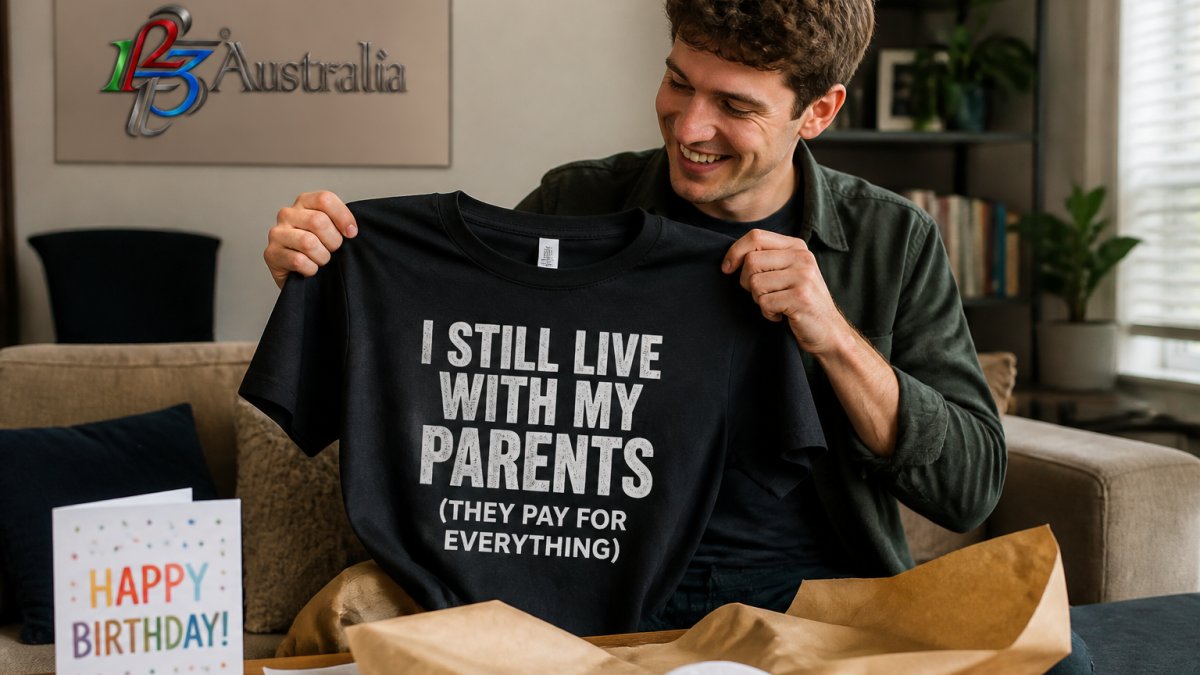
Teams and events are where bulk orders shine. A custom printed t-shirt with the team name, a date or a logo turns a group into a unit, whether it is a footy club, a buck's party or a work crew. Ordering in bulk usually brings the per-shirt cost down and keeps everyone matching.
What a Personalised T-Shirt Costs: A Real Breakdown
Pricing is where most shoppers get confused, so here is how the numbers actually stack up. A single custom printed t-shirt at 123t Australia starts at $35.75, which covers the garment, the print and the personalisation. That figure is a starting point, not a fixed price, because five things move it up or down.
Garment type and weight. A standard 165gsm ring-spun cotton tee sits at the base price.
Print area and placement. A small left-chest print uses less ink and film than a full front print, and a large back print uses more again. Most printers price by print size band, so a 10cm chest logo and a 30cm full-front design are not the same job even on the same shirt.
Number of colours and complexity. A one-colour screen print is cheaper than a four-colour print because each colour needs its own screen and setup. Full-colour photo prints take more production time than simple text, and embroidery is priced partly by stitch count, so a dense logo costs more than a simple name.
Quantity. Bulk orders lower the per-shirt price because setup costs spread across more units. A single shirt carries the full setup cost; an order of 20 or more spreads it thin. This is why a team order can land well below the single-shirt price per unit.
Delivery and timing. Standard shipping is included on 123t Australia orders, but timing matters around Christmas and peak periods when networks slow down. Ordering early avoids paying for express options you did not plan for.
A worked example helps. Take a single funny slogan tee on a standard 165gsm cotton shirt with a 28cm chest print: that is the base $35.75. Swap to a heavier 180gsm garment and add a large back print and the price climbs. Order 20 of the same shirt for a footy club and the per-unit price drops because the setup is shared. The exact figure depends on the combination, which is why a quote beats a guess.
Cheaper shirts exist, and the gap usually shows up in the fabric weight, the print durability and the fit. A shirt that fades after five washes is not a bargain, it is a gift that gets quietly retired to the rag pile.
Caring for Your Shirt So the Print Lasts
A printed shirt lasts years with the right care and months with the wrong habits. The rules are simple and worth taping to the laundry door.
- Wash inside out to protect the print from abrasion
- Use cold water, ideally 30°C or below, and a gentle cycle
- Skip the tumble dryer; heat is the fastest way to crack a print
- Iron inside out and never directly over the design
- Avoid bleach and fabric softener, which break down print adhesion
- Wash with similar colours to stop dye transfer onto light prints
Hang the shirt to dry in the shade. Direct sun fades both the garment and the print over time. Follow those steps and a good print will outlast the novelty of the joke.
Pick Your Design and Order Your Shirt
Here is the part that trips people up: knowing all of this and then still leaving the order to the last minute. A personalised t-shirt is only the perfect gift if it arrives in time and fits the person you bought it for. That means checking the size chart, preparing a clean file and ordering with a buffer before the birthday or Christmas deadline. If you want a step-by-step walkthrough of the ordering process, read how to order custom shirts.
At 123t Australia, we are a family-run business, so we know what a difference a well-made shirt makes. Every order comes with free shipping, our garments are made from high-quality ring-spun cotton, and our 60-day return policy means you are not stuck if something is not right. Our novelty designs cover the whole family.
If you are ready to make someone laugh, order a personalised novelty t-shirt and get it sorted today. Sign up with 123t Australia and find the design that fits your mate perfectly.

Frequently Asked Questions
How much does a personalised t-shirt usually cost?
At 123t Australia, the men's personalised novelty tees in the Your Text range are $35.75 each. That covers a 165gsm ring-spun cotton shirt with your own text added to the design. Bulk orders bring the per-shirt figure down, and free shipping applies. Compare that against the cost of a generic gift nobody uses and the maths works out well, especially since the shirt gets worn again and again rather than sitting in a drawer.
How do I make a personalised t-shirt that doesn't look cheap?
Start with the garment. A 165gsm ring-spun cotton shirt with a seamless double neck collar and double-needle hems holds its shape far better than thin budget blanks. Keep the design simple, use a high-resolution image, and pick a print placement that suits the artwork. Follow the care label too: wash at 40 degrees or cooler, turn the shirt inside out, and skip the tumble dryer. Most faded, cracked prints come from tumble drying, not from the printing itself.
What should I put on a personalised t-shirt as a gift?
An in-joke beats a generic slogan every time. Think about the recipient's nickname, a running family joke, a hobby they never shut up about, or a milestone like a 40th birthday. The Your Text range lets you drop that phrase straight into an existing funny design, so the shirt reads as made for them. For team or event shirts, a surname and number on the back works well and stays wearable long after the day.
Can I order a custom printed t-shirt in a rush?
Turnaround depends on the design and print method, so confirm the delivery estimate before you pay, particularly in the weeks before Christmas. If you are cutting it fine, have your artwork ready as a high-resolution file with any logos supplied separately, and choose a standard print placement rather than something unusual. Ordering early remains the safest move for dated gifts, and 123t Australia's 60-day return policy gives you a fallback if the fit is wrong.


