

Quick Summary
To choose the right size for custom hoodies, first decide on your fit style, then measure your chest and body length. Compare these with the garment measurements on the size chart rather than the letter you usually wear. Choose the larger size if you are between two sizes for a relaxed fit, or the smaller size for a standard fit.
- Decide between standard, relaxed or oversized fit before looking at numbers.
- Measure your chest under the arms and across the shoulder blades.
- Double the pit-to-pit figure when measuring a hoodie you already own.
- A 10-15cm chest ease suits a relaxed or oversized look.
- Wash custom hoodies cold and avoid tumble drying to protect the fit.
Table of Contents
- Why Custom Hoodie Sizing Catches People Out
- Start With the Fit You Want: Standard, Relaxed or Oversized
- How to Take Measurements of a Hoodie
- Reading a Custom Hoodie Size Chart
- Comparing Your Measurements With a Hoodie You Already Own
- Oversized Hoodie Sizing: When to Size Up and by How Much
- Hoodie Sizing for Group Orders
- Fabric Shrinkage and Print Placement: Final Checks Before You Order
- Placing Your Order With the Right Size Confirmed
- Frequently Asked Questions
Why Custom Hoodie Sizing Catches People Out
Last Updated: October 31, 2026
Getting the size wrong on custom hoodies is frustrating, and it happens far more often than it should. A hoodie that looks perfect on a product page can arrive tight through the shoulders or hang past the fingertips. The reason is usually simple: most people pick a size based on the label they wear in shops, not on the measurements of the garment itself.
This guide from 123t Australia walks you through how to choose the right size for custom hoodies. You will learn how to pick a fit style, take measurements, read a size chart, and check your order before it goes to print. Hoodies are designed and sold in-house, so sizing questions come up often.
Sizing varies more than most shoppers expect. Two hoodies labelled "Large" can differ by several centimetres in chest width. Our adult hoodies are a good example. On the adult hoodie size chart, the chest measurement for a Large is 120cm, while a Medium is 110cm. You can see a real hoodie and its sizing on the Alcohol Choose Your Weapon hoodie page. That gap matters when you are choosing between a snug fit and a roomy one.

Here is what matters most:
- Know the fit you want before you look at numbers.
- Measure a hoodie you already own that fits well.
- Compare garment measurements, not just size letters.
- Allow for shrinkage and print placement on the final order.
Most sizing mistakes come from skipping one of these steps. The sections below cover each one in order, so you can order with confidence.
Start With the Fit You Want: Standard, Relaxed or Oversized
Before you touch a tape measure, decide how you want the hoodie to sit on your body. The fit style changes which measurement you should aim for, so it is the first decision to make.
A standard fit sits close to the body with little extra room. It suits everyday wear and layering under a jacket. A relaxed fit adds a bit of room through the chest and sleeves, which feels comfortable for daily wear. An oversized fit is roomier again, with a looser body and longer drop through the shoulders.
Think about where you will wear it:
- Gym or sport: choose standard, so the fabric does not catch on things.
- Casual weekends and layering: choose relaxed.
- Streetwear look or lounging: choose oversized.
If you are buying as a gift, ask the recipient or pick the fit that works for most people. A relaxed fit suits the widest range of body types.
How to Take Measurements of a Hoodie
A repeatable sizing method has two halves: measure your body, then measure a hoodie that already fits you well. Most sizing mistakes happen because people do only one half. The process below gives you both sets of numbers so you can match them to any garment chart with confidence.
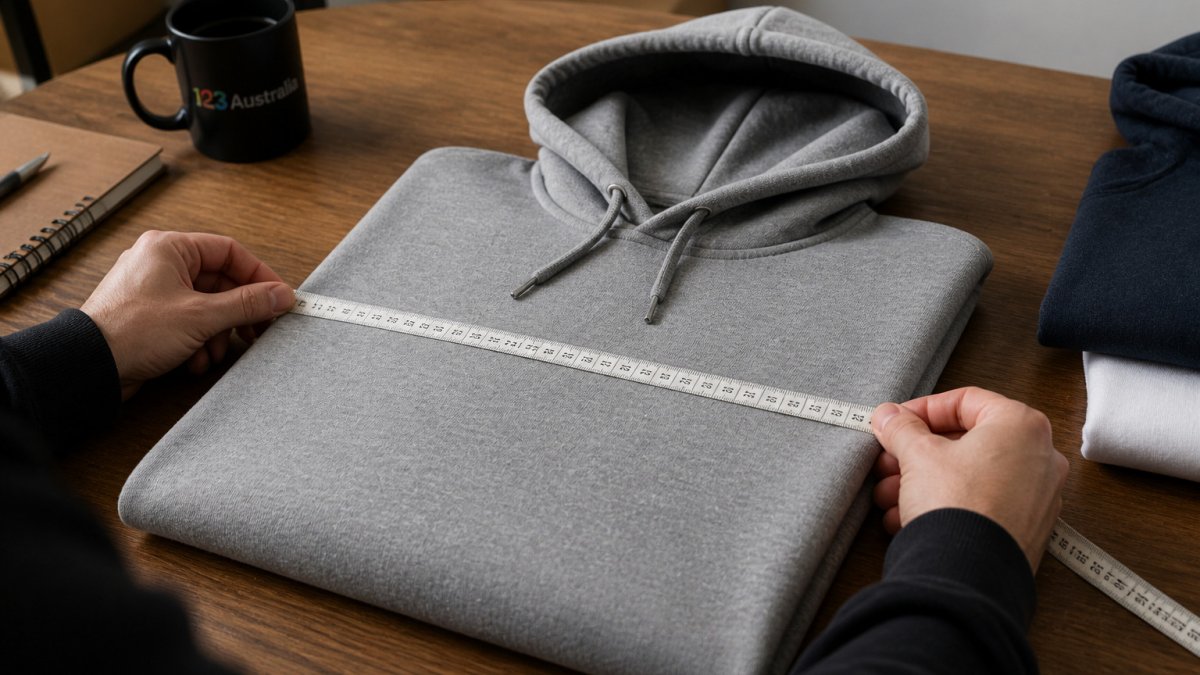
You will need a soft tape measure, a flat surface, and a way to record figures in centimetres. Take your body measurements over light clothing, keep the tape snug but not tight, and stand naturally rather than holding your breath or squaring your shoulders.
Step 1: Measure Your Body
Record these four figures:
- Chest: Wrap the tape around the fullest part of your chest, under the arms, and across the shoulder blades. Keep the tape level all the way around.
- Shoulder width: Measure from the bony point at the edge of one shoulder across the back to the same point on the other shoulder.
- Body length: Measure from the highest point of your shoulder, near the neck, straight down to where you want the hem to sit, typically the top of the hips for a standard fit, or lower for a relaxed or oversized look.
- Sleeve length: Measure from the shoulder point down the outside of a slightly bent arm to the wrist bone.
Write these down. They are your baseline, and they do not change between manufacturers.
Step 2: Measure a Hoodie That Fits
Lay the hoodie flat on a table with the zip closed or the pullover smoothed out, and fold the sleeves neatly at the sides. Smooth out creases before you start. Use a soft tape measure rather than a metal rule, because a rigid rule will not follow the curves of the fabric.
Measure these garment figures:
- Chest width (pit to pit): Measure straight across from one armpit seam to the other, without stretching the fabric. Double the figure, because this measures only half the garment. If one side measures 55cm, the chest width is 110cm.
- Body length: Start at the highest point of the shoulder, near the neckline seam, and run the tape down the back to the bottom hem. Keep the tape straight and avoid pulling it.
- Shoulder width: Measure across the back from one shoulder seam to the other.
- Sleeve length: Measure from the shoulder seam to the cuff along the outside of the sleeve.
Step 3: Compare Garment to Body
The difference between your body chest and the garment chest width is the ease, the extra room the hoodie gives you. A standard fit typically has 5-10cm of ease, a relaxed fit 10-15cm, and an oversized fit 15cm or more. If your body chest is 100cm and a size chart lists a 110cm chest, that size gives you 10cm of ease, which sits at the relaxed end of standard.
Use the same logic for length: compare the garment length with your body length measurement to see where the hem will land. If the garment length is shorter than your body length, the hem will sit higher than you planned.
Common Measurement Mistakes
- Measuring a stretched hoodie. Let the fabric relax before you measure, or you will record a chest width that is too large.
- Forgetting to double the pit-to-pit figure. A single-side measurement is half the garment, not the full chest.
- Measuring over bulky clothing. Body measurements taken over a thick jumper will push you up a size unnecessarily.
- Using a hard ruler. It will not follow seams and curves, so the figure will be inaccurate.
Once you have both sets of numbers, you can read any size chart with a clear target rather than relying on the letter you usually wear.
Reading a Custom Hoodie Size Chart
Size charts list garment measurements, not body measurements. That is the key difference, and it trips up many shoppers.
Our adult hoodie size chart runs from Small to 5XL. Each size lists two figures: length and chest. For example, a Medium has a length of 66cm and a chest of 110cm. A 2XL has a length of 72cm and a chest of 140cm.
Keep these points in mind when you read it:
- Chest is the main figure for choosing between two sizes.
- Length matters if you want the hem at a particular point.
- Sizes can vary by 1-4cm from the listed figures, so treat them as a guide.
- 3XL, 4XL and 5XL are only available in black on some designs, so check before you choose a colour.
If your chest measurement falls between two sizes, choose the larger size for a relaxed fit. Choose the smaller size for a standard fit.
The adult hoodie size chart lists two garment figures for each size, so you can compare them with your own measurements:
| Size | Length (cm) | Chest (cm) |
|---|---|---|
| Medium | 66 | 110 |
| 2XL | 72 | 140 |
| Large | , | 120 |
Comparing Your Measurements With a Hoodie You Already Own
If you have a hoodie that fits well, you can use it as a reference point. This is often the quickest and most accurate method.
Alcohol Choose Your Weapon - Funny Novelty Hoodies Hoodie →
Measure the favourite hoodie's chest width and length, using the steps above. To compare against a similar style, you can browse the Browns Always Right hoodie. Then compare those figures with the size chart. Find the size whose chest and length are closest to your reference hoodie.

For example, suppose your favourite hoodie measures 112cm across the chest and 67cm in length. That sits closest to the Medium, which measures 110cm in chest and 66cm in length. In this case, a Medium is a good starting point.
Two quick checks help you decide:
- If the reference hoodie feels loose, go one size smaller.
- If it feels tight, go one size larger.
Keep the fabric in mind too. A heavier fabric may feel bulkier than a lighter one with the same measurements. The hoodies are made from a 280gsm blend of 80% cotton and 20% polyester.
Oversized Hoodie Sizing: When to Size Up and by How Much
Oversized hoodies need a different approach. Because the look depends on extra room, you may need to size up from your usual size.
As a rule of thumb, if you want an oversized look, choose a size that gives you 10 to 15cm more chest width than your body measurement. For many people, that means going up one size. For a very relaxed look, you may go up two sizes.
Be careful about sizing up too far. A hoodie with too much width can look shapeless, and the shoulder drop can swamp a smaller frame. If you are unsure, go up one size first and check the length. You can always wear a looser fit, but it is harder to make a tight one comfortable.
Oversized styles also tend to be longer. Check the length figure on the size chart, since a longer body may cover more of the hips.
Hoodie Sizing for Group Orders
Group orders fail on sizing for predictable reasons: people guess their size, respond late, or ask for a fit they do not actually want. A simple system removes most of that risk before the order goes to print.
Collect Measurements, Not Size Labels
Asking each person for their usual size invites error, because size labels are not standardised between manufacturers. If you are planning the wider project, see the Custom Print Tees design, print and order guide. Instead, ask everyone for two figures in centimetres: chest width and body length, measured using the method above. If they cannot measure themselves, ask them to measure a hoodie they already own and send the pit-to-pit and length figures.
Give everyone the same short template so the responses are comparable:
- Name
- Chest (cm)
- Body length (cm)
- Preferred fit (standard, relaxed, or oversized)
- Size on the chart you have matched them to
Handle Uncertain Responses
Some people will not measure themselves, and some will guess. A practical approach is to set a default: match anyone who does not respond to the size that fits the median chest measurement in your group, and note it on the list. For anyone who is between two sizes, choose the larger size for a relaxed fit and the smaller size for a standard fit. If the group includes people with a wide range of body shapes, avoid relying on height and weight alone, the chest and length figures are far more reliable.
Plan Quantities Across the Group
Once you have the size list, count how many of each size you need. When you are ready to place the order, follow the step-by-step guide to ordering custom shirts. Then add a small buffer to the most common sizes, typically one or two extra in the middle sizes, to cover late additions or a mis-measured response. Check colour availability at the same time, because some ranges restrict the largest sizes to certain colours, and a size that is unavailable in the chosen colour will force a substitution.
Build a Simple Size Register
Keep one spreadsheet or list with each person's name, measurements, matched size, fit preference, and colour. Share it with whoever is placing the order so there is a single source of truth. When the order arrives, use the register to label and distribute garments rather than guessing from the packaging.
Confirm Before You Print
Send the final size list back to the group for a quick confirmation before the order is placed. A single review round catches most errors while changes are still free. Once the garments are printed, sizing cannot be adjusted, so the confirmation step is the last cheap opportunity to get it right.
Fabric Shrinkage and Print Placement: Final Checks Before You Order
Before you place the order, check two final details: how the fabric will behave, and where the print will sit.
Cotton blends can shrink slightly after washing. The hoodies are machine washable, and cold washing is recommended. Do not tumble dry or iron directly over the logo.
Print placement also affects how the hoodie looks on the body. Larger prints across the chest sit differently on a relaxed or oversized fit than on a standard one. If your design has a large front print, consider how it will look on your chosen size. Check the design file and make sure it is sized correctly for the garment. Before committing, read the return policy for custom apparel to see what happens if the size is wrong.
Watch out: a hoodie that fits perfectly on the day it arrives may feel tighter after the first few washes. If you are between sizes, choose the larger one.
Placing Your Order With the Right Size Confirmed
Once you know your size, you are ready to order. Work through this short checklist before you click the final button:
- Confirm the fit style you want: standard, relaxed, or oversized.
- Check your chest and length measurements against the size chart.
- Compare with a reference hoodie if you have one.
- Review the colour and size availability for your choice.
- Check the design and print placement on the product page.
- Note the care instructions so the hoodie keeps its fit.
If you are still unsure after working through these steps, choose the size that matches your chest measurement. The chest figure does the most to determine fit.
Frequently Asked Questions
Does hoodie fabric shrink after washing?
Yes, cotton-rich hoodies can shrink a little, especially in the first few washes. The 123t Australia hoodies are 80% cotton and 20% polyester with a 280 gsm weight, and they are machine washable, with cold washing recommended. Do not tumble dry or iron directly over the logo. If you are between sizes, the safer choice is usually the larger size, as a hoodie that is slightly roomy will still fit well after a wash.
Should you size up when ordering a custom hoodie?
It depends on the fit you want. If you prefer a standard fit, choose the size that matches your chest measurement on the size chart. If you want a relaxed or oversized look, sizing up one size is a common choice. Compare your chest measurement with the chest width listed in the chart rather than relying only on your usual shirt size, because cuts vary between styles and brands.
What measurements should you check before ordering a custom hoodie?
Check the chest width and the length from the shoulder to the hem. These two numbers matter most for a hoodie. Measure a hoodie you already own that fits well, lay it flat, and compare those figures with the adult size chart. Sizes can vary by 1 to 4 cm, so if your measurement falls between two sizes, decide whether you want a closer or looser fit before you choose.
How do you choose hoodie sizes for a group order?
Collect each person's chest measurement and preferred fit before ordering, rather than guessing from their everyday sizes. Group members often differ in build and preferred fit, so note who wants standard and who wants relaxed. Order a sample if possible, and remember that sizes can vary by 1 to 4 cm, so allow a small margin when the group is spread across sizes.


