


Table of Contents
- Marketplace vs Independent Storefront: What You Are Really Choosing
- Production and Fulfillment Models Compared
- Profit Margins and Pricing Structures Explained
- Customization, Branding Control and Print Quality
- Custom Apparel Printing Turnaround Times and Shipping Logistics
- Finding the Best Custom T-Shirt Printing Australia Offers
- Looking for a Threadheads Alternative for Funny T-Shirts?
- Tax, Legal and Environmental Considerations for Local Printing
- Frequently Asked Questions
Last Updated: September 16, 2026
Marketplace vs Independent Storefront: What You Are Really Choosing
Choosing between Redbubble vs local custom printers comes down to one question: do you want your designs sitting on a global marketplace, or do you want full control of your own storefront? That single decision shapes your margins, your brand, and how much of the work you actually own. This guide from 123t Australia breaks down what each path really costs you.
Redbubble is a print-on-demand marketplace. You upload artwork, the platform handles production, shipping and customer service, and you earn a royalty on each sale. A local custom printer works differently: you deal with a real production team, often on a first-name basis, and you control the product, the packaging and the customer relationship.
The trade-off is exposure versus ownership. Marketplaces put your work in front of existing traffic, but you compete on price against thousands of near-identical listings. Independent printing gives you a brand, a repeat customer base and better margins per unit, but you carry the marketing load yourself.
Australian Competition and Consumer Commission guidance on online shopping notes that consumers increasingly check where and how a product is made before buying, which matters when you are building a brand rather than renting shelf space on someone else's platform.
Production and Fulfillment Models Compared
Fulfillment is where the two models diverge most sharply. On a marketplace, production and shipping are handled for you, which keeps your overhead costs low but leaves you with no say in turnaround time or packaging. With a local printer, you are working with production facilities that print, check and dispatch your order, and you can usually ask questions about stock, print methods and delivery windows before you commit.
Here is how the two models stack up on the operational basics:
| Factor | Marketplace Model | Local Custom Printer |
|---|---|---|
| Production control | None | Full visibility |
| Inventory management | Not your concern | You plan stock levels |
| Turnaround time | Set by platform | Agreed with printer |
| Packaging | Generic | Custom branding possible |
| Customer service | Handled by platform | You or the printer handles it |
The catch with marketplaces is that you are one listing among millions. When something goes wrong with a print, you are filing a support ticket, not calling a person. With a local printer, quality assurance happens before the item ships, and a faulty print is usually a phone call away from being fixed.
Profit Margins and Pricing Structures Explained
Profit margins are the real dividing line between a marketplace listing and a local print run, but most comparisons stop at "marketplaces take a cut". The useful version is a worked model you can apply to your own numbers.
On a marketplace, the maths runs in one direction. You set a retail price, the platform deducts a fixed base cost for production and shipping, and your royalty is whatever is left. Your only lever is the markup, and because the base cost does not move with volume, your margin percentage is capped no matter how many units you sell. Sell one shirt or one hundred, and the per-unit economics are identical.
Local printing inverts that. You pay a base cost per unit that steps down as quantity rises, then set your own retail price. The margin percentage is yours to define, and the volume discount is the mechanism that makes it work.
A simple way to see the difference is to model three scenarios on the same garment:
| Scenario | Base cost per unit | Retail price | Gross margin per unit |
|---|---|---|---|
| Marketplace, single sale | Fixed, set by platform | Your markup above base | Thin and fixed |
| Local printer, small run | Higher tier | Your price | Moderate, improves with volume |
| Local printer, bulk run | Lowest tier | Your price | Widest, and you control it |
The exact figures depend on garment type, print method and quantity, so request a written quote rather than trusting a website calculator. What matters is the shape of the curve: marketplace margin is flat, local margin improves as you scale. If you want to see how a local operation structures its range and pricing tiers, the product pages break down options clearly, and a quote request will give you the real numbers rather than an estimate.
Three levers decide which model suits you:
- Volume: if you can commit to a bulk run, local pricing rewards you; if you sell one-offs, the marketplace's fixed base cost is simpler.
- Price ceiling: marketplace buyers compare you against near-identical listings, so your retail price is capped by the market; a branded local product can command more because it is not interchangeable.
- Hidden costs: marketplaces look cheap because production is bundled, but you still fund design, listing optimisation and customer acquisition. Local printing looks expensive per unit until you factor in the repeat-purchase value of a customer who bought from you, not from a platform.
A common pattern among sellers who switch to local production is that their first run feels expensive and their third run does not, because the volume tier and the repeat customer base compound. Model your break-even quantity before you commit: the point where your local base cost plus your marketing spend per unit drops below the marketplace's effective cost per sale is the point where going local starts paying.
If you want to see how a local operation structures its range and pricing tiers, the product pages break down options clearly, and a quote request will give you the real numbers rather than an estimate.
Customization, Branding Control and Print Quality
Branding control is the strongest argument for going local. With a marketplace, your product arrives in generic packaging with the platform's branding, not yours. Your customer relationship belongs to the platform, and you have no way to follow up, build a mailing list or encourage a repeat purchase.
A local custom printer lets you control the full brand identity: swing tags, packaging inserts, thank-you cards and the print quality itself.
Print quality also varies more than most buyers realise. What most guides miss is that a design that looks sharp on a screen can print flat on a dark cotton tee, so always ask for a sample before committing to a large run.
Custom Apparel Printing Turnaround Times and Shipping Logistics
Turnaround time is where local printing usually wins, but the reason is a mechanism most guides never explain: fulfilment routing. When you order from a marketplace, your job is assigned to whichever production facility the platform's algorithm selects, based on your address, the product type and current capacity. You cannot see which facility, you cannot ask about its queue, and you cannot request a different one. Your delivery window is an estimate, not a commitment.
A local printer works the other way. You speak to the people who will actually run your job, confirm a dispatch date before you pay, and know which carrier is collecting the parcel. That is the difference between a promise and a guess.
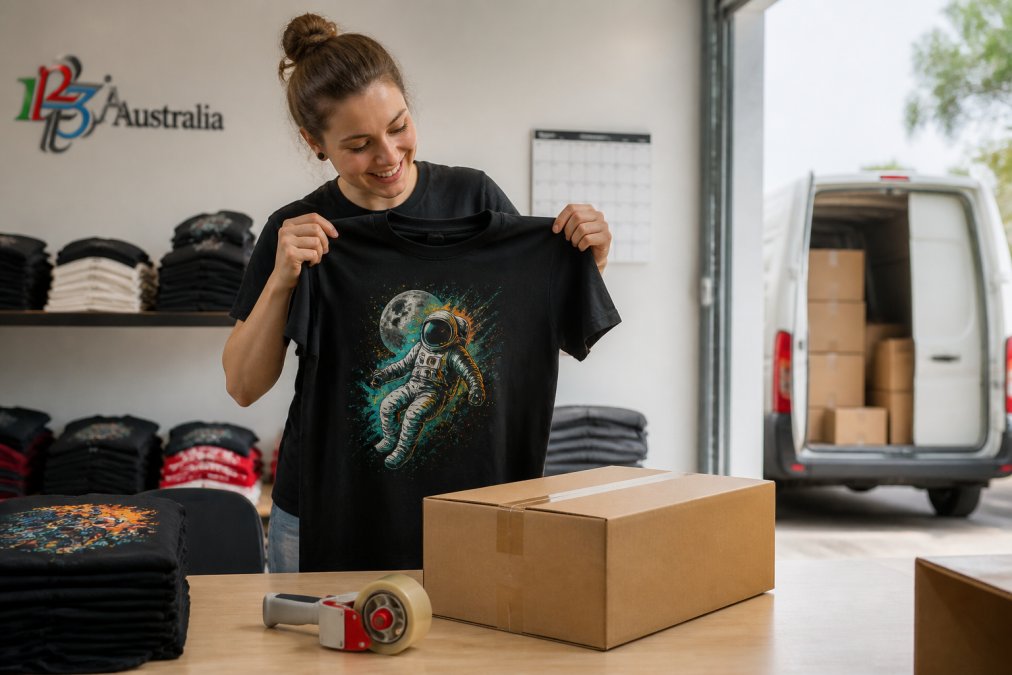
For time-sensitive orders, ask two questions up front: how many business days until dispatch, and which carrier handles delivery. Build in a buffer for birthdays and Christmas, and ask about rush options before you pay, not after.
Shipping costs differ too. Many local printers bundle shipping into their pricing, which simplifies budgeting compared to a marketplace where shipping is calculated per item and per destination. If you are sending multiple gifts to different addresses, that gap widens quickly.
The quality-control workflow most comparisons skip
The bigger logistical difference is not speed, it is where quality control happens. On a marketplace, the first time you see the finished product is when your customer opens the parcel. If the print is misaligned or the colour is off, you are filing a support ticket and waiting, while your customer waits with you.
A local printer lets you inspect before the run.
- Order a single sample first. Never approve a bulk run from a digital mock-up. A design that looks sharp on screen can print flat on dark cotton, and only a physical sample shows you the real result.
- Wash the sample. Print durability is the failure mode buyers complain about most. A sample that survives a few washes tells you more than any product photo.
- Check the details, not just the print. Stitching, hem alignment, tag placement and packaging all affect whether the item feels like a brand product or a generic one.
- Confirm the dispatch date in writing. A confirmed date is what lets you promise your own customer a delivery window.
- Agree the remedy before you order. Ask what happens if a print is faulty, a reprint, a refund, or a credit, and get it in writing.
If you are using a remote or marketplace fulfilment model, you can still run a version of this: order one item to your own address, inspect it, wash it, and treat that as your quality benchmark. The limitation is that you cannot change the production facility, so a good sample does not guarantee the next order comes from the same place.
For anyone building a brand rather than reselling, the local model's real advantage is that quality control happens before the customer sees the product, not after. That is worth more than a day or two of turnaround time.
Finding the Best Custom T-Shirt Printing Australia Offers
The best custom t-shirt printing in Australia comes down to three things: print quality that survives a wash, a turnaround time you can plan around, and a business that answers the phone when something goes wrong.
Start by narrowing your options with a simple checklist:
- Can they show you clear photos of finished work?
- Do they confirm turnaround time in writing before you pay?
- Is there a clear return policy if the print is faulty?
- Do they offer both ready-made designs and full personalisation?
- Are they a local business you can actually contact?
This is where a family-run operation like 123t Australia tends to stand out. We produce in-house designed apparel and novelty gifts, from t-shirts and hoodies to mugs and stubby holders, and we back it with a 60-day return policy. If you want a simple funny tee for a mate's birthday, or a fully personalised gift, the same process applies. You can browse the range and see the quality for yourself before you commit.
Looking for a Threadheads Alternative for Funny T-Shirts?
If you are hunting for a Threadheads alternative for funny t-shirts, the deciding factor is usually design range and how quickly you can get the item in hand. Marketplace-style sellers offer volume, but the humour is often generic and the same joke appears on a dozen listings.
A local printer with in-house designs gives you something different: original humour, printed on quality materials, with the option to personalise the joke for the person receiving it. That personal touch is what turns a novelty tee into a gift someone actually keeps.
The practical test is simple. Search for the joke you want. If it appears on twenty identical listings, it is not unique. If a local printer can tweak the wording, add a name or match a design to a specific occasion, you have found something worth paying for. 123t Australia designs its range in-house specifically so the humour lands and the gift feels considered rather than mass-produced.
Tax, Legal and Environmental Considerations for Local Printing
Two things most comparison guides skip: tax and environmental impact. If you are selling printed apparel as a business rather than buying a one-off gift, you need to understand how goods and services tax applies to your sales and whether you are registered for it. The Australian Taxation Office guidance for small business is the place to start, and it is worth a conversation with an accountant before you scale.
On the environmental side, local production cuts the air freight that marketplace orders often rely on, and shorter supply chains mean less packaging waste. If sustainability matters to your customers, ask your printer about their material sourcing and whether they offer organic or recycled garment options. Sustainability Victoria's guide to sustainable business practices outlines how small operators can reduce waste without adding cost.
Frequently Asked Questions
Is Redbubble print quality good enough for gifts?
Redbubble uses a network of third-party production facilities, so print quality can vary between orders and product types. For a gift you want to feel special, that inconsistency is a risk. If the gift matters, a local printer gives you more control over how the final product looks and feels.
How do custom apparel printing turnaround times compare between Redbubble and local printers?
Redbubble routes orders through production facilities that may be overseas, so turnaround time includes production plus international shipping. That can stretch to weeks depending on the destination and time of year. Local custom printers usually produce and dispatch within days because the supply chain is shorter. If you need a gift by a specific date, ask the printer directly about their current turnaround time and whether they offer rush orders.
What makes a good Threadheads alternative for funny t-shirts?
Look for a printer that creates its own in-house designs rather than relying only on user uploads, offers a clear return policy, and uses quality materials that hold up after washing. A family-run business with a strong customer rating and a straightforward returns process is often a better fit than a large marketplace. Check whether they offer free shipping and whether you can personalise the design, since that flexibility matters for funny gifts.
Are local custom printers more cost-effective than Redbubble for small batch orders?
It depends on what you count as cost. Redbubble's base cost per item may look lower upfront, but you are paying for a marketplace listing and the design is shared across many sellers. Ask for a quote based on your quantity and design complexity to compare fairly.
The hard part is not choosing between a marketplace and a local printer. It is finding a local printer who delivers on quality, turnaround and backup when you need it. At 123t Australia, we handle in-house design, high-quality materials and a 60-day return policy, so you can order a personalised gift or a funny tee without gambling on the print. Browse the range, pick your design, and get started with 123t Australia today.

