


Table of Contents
- What You'll Need to Inspect Quality Custom Apparel
- Understanding Fabric Weight: What is GSM in Clothing
- Check Stitching and Seam Integrity
- Screen Printing vs Embroidery Durability: Which Lasts Longer
- How to Check Print Quality on Shirts
- Inspect Hardware, Buttons and Neck Labels
- Test Colour Vibrancy and Crispness
- Common Mistakes to Avoid When Buying Custom Apparel
- Conclusion
- Frequently Asked Questions
Last Updated: September 1, 2026
What You'll Need to Inspect Quality Custom Apparel
Knowing how to spot quality custom apparel before you buy is the difference between a gift that impresses and one that disappoints after the first wash. This guide walks you through the physical inspection process, fabric weight, thread tension, print durability, and hardware quality, so you can confidently evaluate any custom piece.

The inspection process takes about five minutes per garment and catches the details most buyers miss. These four pillars determine whether a custom shirt will look sharp after ten washes or fall apart after two.
Understanding Fabric Weight: What is GSM in Clothing
GSM stands for grams per square metre, and it's the most reliable way to assess fabric weight and durability in custom apparel. For custom t-shirts, the sweet spot sits between 150-180 GSM. Anything below 150 GSM feels thin and flimsy; the print sits on top rather than becoming part of the fabric, and the garment stretches out of shape after a few wears. Above 180 GSM, the shirt becomes stiff and heavy, which works for premium pieces but is overkill for everyday wear.

When inspecting quality custom apparel, run your fingers across the fabric. A 165 GSM shirt has noticeable weight and substance without feeling like cardboard. The fabric should have a slight give when you pull it, then snap back to shape. If it feels papery or too stretchy, the GSM is likely too low.
Check the product specifications before ordering. Reputable custom apparel makers list GSM openly. If a supplier won't state the fabric weight, that's a red flag.
| Fabric Weight (GSM) | Feel | Durability | Best Use |
|---|---|---|---|
| Below 150 | Thin, flimsy | Poor (fades quickly) | Budget basics only |
| 150-165 | Soft, balanced | Good | Everyday wear, gifts |
| 165-180 | Substantial, premium | Excellent | Long-term wear |
| Above 180 | Stiff, heavy | Very high | Premium/collector pieces |
Check Stitching and Seam Integrity
The stitching is where quality custom apparel separates from cheap imports. A garment can have perfect fabric and a brilliant print, but poor stitching will unravel everything.
Start by examining the neck seam. Run your finger along the inside of the neckline. On quality pieces, you'll feel a taped seam: a thin strip of fabric sewn underneath that reinforces the neckline and prevents stretching. This is standard on 165+ GSM shirts. If the neck feels raw or untaped, the garment will lose shape after a handful of washes.
Next, check the side seams and sleeve hems for double-needle stitching, which creates two parallel lines of thread instead of one. This distributes stress across two thread lines, so if one breaks, the other holds. Single-needle stitching is cheaper but fails faster on frequently washed garments.
Pull gently on the seams. They should resist movement. If the seam puckers or the thread looks loose, the tension was set wrong during production. Proper tension means the thread sits evenly, the fabric doesn't bunch, and the seam lies flat.
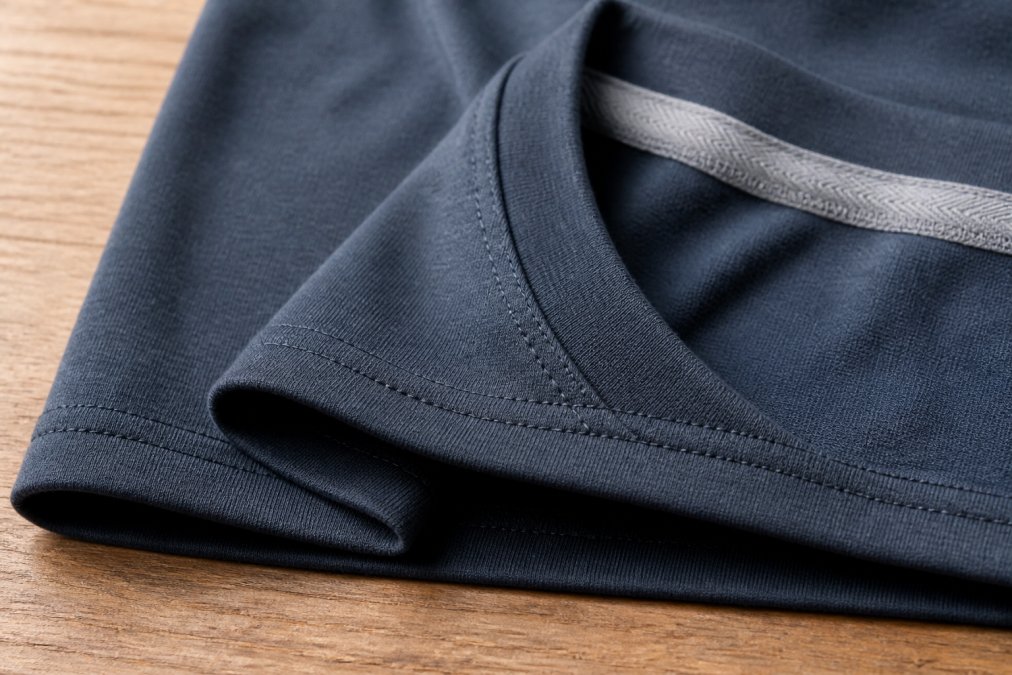
Overlock stitching on the side seams (the zigzag pattern that finishes raw edges) should be tight and even. Loose or uneven overlock stitching means the garment will fray and shed threads in the wash. On quality custom apparel, overlock stitching is barely visible because it's done correctly.
Inspect seams before you buy. If ordering online, request close-up photos of the stitching from the supplier. Any reputable custom apparel maker will provide them.
Screen Printing vs Embroidery Durability: Which Lasts Longer
The print or embroidery on custom apparel determines how the piece looks after repeated washing. Both methods have trade-offs.
Screen Printing: Ink Type and Durability
Water-based inks sit on top of the weave and feel softer. They're made from pigment suspended in a water-soluble binder that cures through air drying and heat. Water-based prints fade noticeably after 50-80 washes, with colour loss accelerating after wash 30. The fading pattern is gradual and even.
Plastisol inks use a PVC-based carrier that cures into the fabric fibres through heat. They last longer, typically 100-150+ washes, because the PVC binder resists water and detergent breakdown. The trade-off is feel and breathability. Plastisol prints can crack if the garment is folded repeatedly in the same spot, especially if over-cured.
How to Assess Print Longevity Before Purchase
Ask the supplier which ink type they use and request wash-test data. Quality custom apparel makers have tested their prints through 20, 50, and 100+ wash cycles and can show you the results. For water-based prints, ask about colour-fastness testing using ISO 105-C06 or equivalent standards. For plastisol prints, ask about cure temperature and duration, proper curing is 160-180°C for 2-3 minutes.
Perform a simple flex test on the print. Gently bend the shirt at the printed area. A well-cured print flexes with the fabric without cracking or feeling stiff. If it cracks immediately or feels like a plastic film, the cure was wrong.
Embroidery: Stitch Density and Thread Quality
Embroidery uses thread stitched into the fabric and is more durable than either ink type if executed correctly. Embroidered designs can survive 200+ washes because the thread is mechanically locked into the fabric.
Durability depends on stitch density (stitches per square inch) and thread quality. Quality embroidery uses polyester thread rated for 200+ wash cycles and stitch density of 400-600 per square inch. Ask whether they use a backing material (stabiliser) underneath the embroidery to prevent puckering and thread breakage.
The downside is cost and practicality. Embroidery works for logos and small designs but is impractical for large, detailed prints with many colours.
Which Method for Your Design?
For novelty designs with lots of colour and detail, screen printing is standard. For corporate logos or simple text, embroidery offers better longevity and a more premium feel. Quality custom apparel makers execute both flawlessly and can prove it with wash-test data.
How to Check Print Quality on Shirts
A crisp, vibrant print catches the eye first, but print quality is about how it looks after five washes, fifty washes, and a year of regular wear.
Examine the print edges under bright light. On quality custom apparel, the edges are sharp and well-defined. Fuzzy or bleeding edges indicate poor registration (misalignment between colour layers) or improper curing, and the print will crack and peel sooner.
Check colour vibrancy. Hold the shirt up to natural light and then artificial light. True colours shouldn't shift dramatically between lighting conditions. If the red looks dull indoors but bright outdoors, the ink concentration is too low.
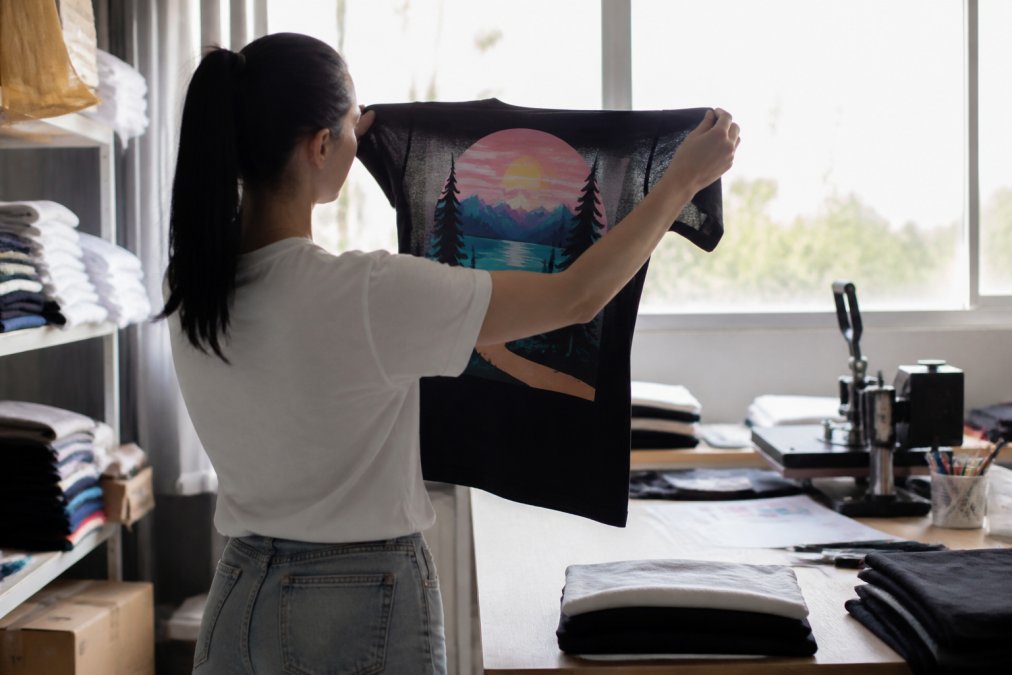
Feel the print. Run your finger across it. A well-cured screen print should feel slightly raised but not thick or rubbery. If it feels like a plastic film on top, the ink was over-applied. If it feels barely there, it was under-applied and will fade fast.
Opacity matters for dark designs on light shirts and vice versa. A dark print on a white shirt should be completely opaque. If you can see the shirt colour through the print, the ink coverage was insufficient.
Test the print's flexibility. Gently bend the shirt at the print. Quality prints flex with the fabric without cracking. Poor prints crack immediately or feel stiff and brittle.
Inspect Hardware, Buttons and Neck Labels
The small details reveal a maker's commitment to quality custom apparel. Buttons, zippers, and neck labels are where corners get cut most often.
Buttons should feel solid and sit flush against the fabric. Cheap buttons feel hollow and rattle when tapped. Buttonholes should be reinforced with stitching that prevents fraying. If the buttonhole looks raw or unfinished, the garment wasn't built to last.
For hoodies and jackets, check the zipper. Slide it up and down several times. It should move smoothly without catching or grinding. Poor-quality zippers jam or separate, and replacing them is often more expensive than buying a new garment.
Neck labels should be securely attached with multiple stitches. A label that's barely sewn in will peel away or tear off. On quality custom apparel, every detail is finished properly.
Check for loose threads anywhere on the garment. A few loose threads are normal, but excessive loose threads indicate poor quality control.
Test Colour Vibrancy and Crispness
Colour vibrancy and crispness make a design pop. But vibrant colour fades if the ink isn't formulated correctly or the fabric isn't prepared properly.
Before washing, examine the colour under different lighting. In natural daylight, the colour should be rich and saturated. Under fluorescent light, it shouldn't shift dramatically. This indicates the ink has good pigment load and the dye bath was applied evenly.
For printed designs, check whether the colour is consistent across the entire print. Some areas shouldn't be noticeably darker or lighter than others. Inconsistency suggests uneven application or varying ink concentration. Quality custom apparel has uniform colour throughout.
Test crispness by looking at fine lines and small text. They should be sharp and readable, not blurry or broken. If small text looks fuzzy, the screen mesh was too coarse or the print pressure was inconsistent.
Perform a simple wash test if the supplier allows it. Wash the garment once in warm water with mild detergent, then air dry. Compare the colour to the original. Minimal colour shift after one wash indicates quality custom apparel.
Common Mistakes to Avoid When Buying Custom Apparel
Most people make the same errors when evaluating quality custom apparel.
Mistake 1: Judging quality from photos alone. Online photos are lit and edited to look perfect. Always request samples or close-up photos of seams, stitching, and print edges before committing to a large order.
Mistake 2: Ignoring fabric weight. A shirt that feels thin won't last. Check GSM before ordering. If a supplier won't state it, move on.
Mistake 3: Assuming all screen printing is the same. Water-based and plastisol inks behave differently. Water-based feels softer but fades faster (50-80 washes). Plastisol feels thicker but lasts longer (100-150+ washes). Ask which ink type the supplier uses and request wash-test data.
Mistake 4: Skipping the seam inspection. Seams are where cheap garments fail first. Double-needle stitching, taped necklines, and tight overlock stitching are non-negotiable. If you can't inspect in person, request detailed photos.
Mistake 5: Ordering without a sample. Bulk orders without samples are risky. A sample costs money upfront but saves money and headaches later. This is standard practice for quality custom apparel makers.
Mistake 6: Not vetting the supplier's quality control process. Before placing a large order, ask the supplier about their quality assurance steps:
- Do they inspect every garment before shipping, or only a sample? Quality makers inspect 100% of pieces or use a documented sampling protocol.
- Do they test prints through multiple wash cycles? Ask for wash-test data at 20, 50, and 100+ washes.
- Do they have a documented process for stitching and seam quality? Ask whether they use double-needle stitching as standard, whether necklines are taped, and whether they check seam tension.
- What's their defect rate and how do they handle it? A quality maker will have a low defect rate (under 2%) and a clear replacement policy.
- Do they use the same production facility for all orders, or do they outsource? Consistency matters. Ask whether they produce in-house or partner with specific certified facilities.
Mistake 7: Not asking about wash testing. Reputable suppliers have tested their products through multiple wash cycles. Ask how many washes their prints survive and whether they've tested colour-fastness and garment shrinkage.
Mistake 8: Overlooking sustainability and ethical sourcing. Ask whether the supplier uses certified sustainable fabrics (GOTS-certified organic cotton) or ethical production standards (Fair Trade). Suppliers committed to ethical sourcing tend to invest in quality processes as well.
Conclusion
Spotting quality custom apparel comes down to inspecting four key areas: fabric weight (GSM), stitching integrity, print durability, and hardware finishing. A 165 GSM shirt with double-needle hems, taped necklines, and well-cured screen printing will outlast cheaper alternatives by years.
When you're ready to order, 123t Australia offers custom apparel built to these standards. Our tees use 150-165 GSM ring-spun cotton, double-needle stitching on all hems, and taped necklines. Every design is screen-printed with proper curing and colour-fastness testing. We back this with a 60-day return policy, so you can inspect your order with confidence. Browse our collection and request a sample before ordering in bulk. Quality custom apparel is worth the investment.
Frequently Asked Questions
Q: How can I tell if a t-shirt fabric is high-quality?
A: High-quality t-shirt fabric typically has a GSM (grams per square metre) of 160-180 for standard wear. Feel the fabric between your fingers, it should be soft but substantial, not thin or flimsy. Check the label for natural fibres like 100% ring-spun cotton, which offers better durability and comfort than synthetic blends. Run the stretch test: pull the fabric gently and release. Quality fabric recovers quickly to its original shape without pilling or thinning.
Q: What are the signs of poor-quality screen printing?
A: Poor screen printing shows cracking, peeling, or fading after just a few washes. Look for uneven ink coverage, blurry edges, or colours that appear dull and flat. Quality prints have sharp registration (clean, aligned edges), consistent opacity, and feel smooth to the touch. Avoid garments where the print feels stiff or plastisol ink sits heavy on the fabric. Always check the care instructions, quality prints can handle regular machine washing when turned inside-out.
Q: How do I check the durability of custom embroidery?
A: Examine stitch density: quality embroidery has tight, even stitches with no loose threads or gaps. Run your finger over the design, it should feel smooth and secure, not rough or raised. Check that the backing is properly applied; it prevents puckering and keeps stitches stable through washing. Gently pull at the edges of the design; threads should not lift or unravel. Quality embroidery withstands multiple washes without fraying or losing definition.
Q: Why does custom apparel from 123t Australia cost more than some alternatives?
A: Quality materials and construction justify the price. 123t Australia uses 100% ring-spun cotton at 150-165 GSM with double-needle hems, taped seams, and seamless neck collars, all features that extend garment life. In-house design and quality control mean fewer defects and better print durability. You're also paying for a family-run business with a 60-day return policy and a 5.0 customer rating, not a mass-production operation cutting corners on fabric or labour.
This article was written using GrandRanker

