


Table of Contents
- Why Custom Mugs Make the Best Family Gifts
- How to Design a Custom Mug: Step-by-Step
- Custom Coffee Mugs with Names: Ideas for Every Family Member
- Best Materials for Personalised Drinkware: A Comparison Guide
- Sublimation Printing: Why It Keeps Your Design Vibrant
- Dishwasher-Safe and Microwave-Safe: What to Look For
- Bulk Orders for Family Reunions and Events
- Eco-Friendly Custom Mugs: Sustainable Printing Options
- Pricing and Value: What You Get for Your Money
- Frequently Asked Questions
Last Updated: September 13, 2026
Why Custom Mugs Make the Best Family Gifts
A custom mug is a personalised ceramic or travel cup printed with a name, photo, message, or in-joke, made as a one-off or in bulk for a specific person. Few gifts survive daily use the way a coffee mug does. A shirt gets worn on weekends. A mug gets picked up every single morning.

That daily ritual is exactly why custom mugs for family gifts work so well. Every time Dad pours his first coffee, he sees the kids' handwriting on the side. Every time Nan makes her tea, there's her name in bold print. The gift keeps showing up long after the wrapping paper is gone.
Below, we'll show you exactly how to pick a mug that suits each family member, plus the quality checks most buyers skip.
How to Design a Custom Mug: Step-by-Step
Designing a custom mug takes about 15 minutes once you know the sequence: pick a template, set your layout, upload high-resolution artwork, then check the print preview before ordering. Skipping the preview step is the most common reason buyers end up disappointed.
Here's the full process:
- Choose your mug style (standard 11oz coffee mug)
- Select a template that matches your occasion
- Add your custom text and names
- Upload artwork at 300 DPI or higher
- Position the design using the live preview
- Confirm the wrap-around and handle clearance
- Place your order, or save the design for a bulk run
Choosing Your Template and Layout
Templates remove the guesswork. Most design tools offer pre-set layouts for birthdays, Christmas, and family reunions, so you're adjusting rather than starting from a blank canvas.
Two layout rules matter. Keep critical text at least 1cm from the handle, and leave a margin of 1-2cm around the edges so the print doesn't crowd the rim. A name that runs into the handle looks rushed; the same name centred with breathing room looks deliberate.
Uploading High-Resolution Artwork
Image quality decides whether your photo looks sharp or soft. Aim for 300 DPI at the final print size. A photo that looks fine on a phone screen can still print blurry if it's been compressed or screenshotted.
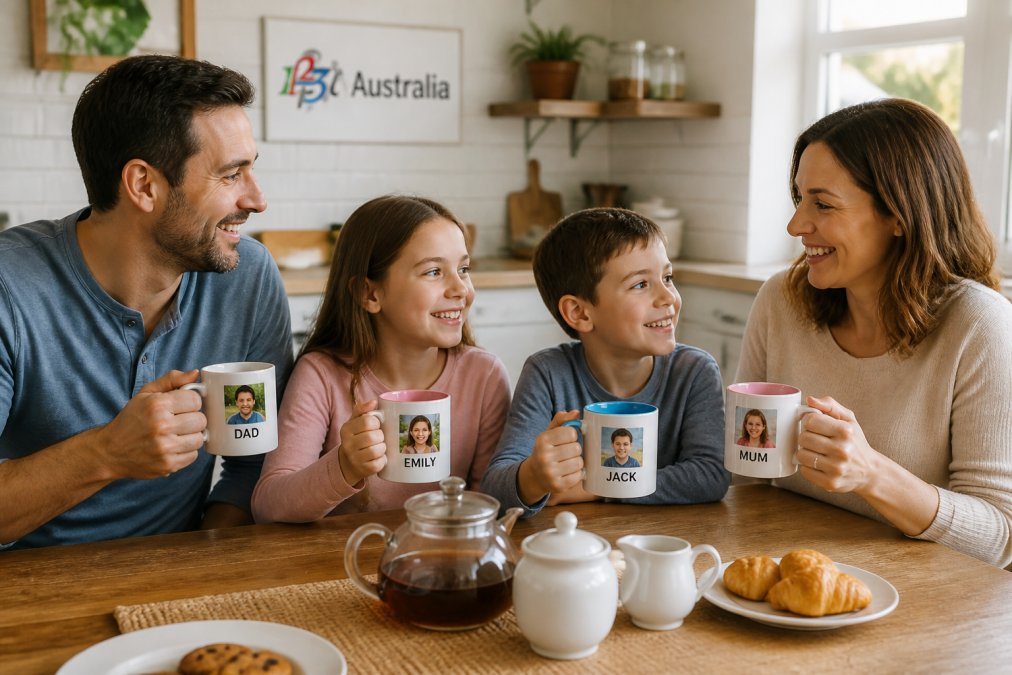
Custom Coffee Mugs with Names: Ideas for Every Family Member
Custom coffee mugs with names are the simplest way to make a gift feel personal. The name does the heavy lifting, and everything around it just adds character.
A few approaches that consistently land well:
- For Dad: a bold "Best Dad" print with the kids' names underneath
- For Mum: a floral template with her name in script
- For siblings: matching mugs with their names and a shared in-joke
- For grandparents: a photo collage with each grandchild's name
- For teenagers: a travel mug with a minimalist initial
The trick is matching the tone to the person. A gag mug suits the brother who sends memes at 6am. A soft script suits the aunt who hosts every Christmas.

Design Inspiration for Specific Family Dynamics
Generic "family" designs often fall flat because every family has its own shorthand. Lean into yours.
For a blended family, a mug listing every household member's name in order of arrival works better than a standard "Family" print. For siblings spread across different cities, matching mugs with each person's city printed beneath a shared surname make a small, warm connection. For a family with a long-running joke, print the punchline and nothing else. The people who get it will get it immediately.
Best Materials for Personalised Drinkware: A Comparison Guide
The best material for personalised drinkware depends on how the mug will be used. Ceramic suits daily coffee at home. Each has trade-offs in weight, heat retention, and print durability.
| Material | Best For | Heat Retention | Print Durability | Care |
|---|---|---|---|---|
| Ceramic | Daily home coffee | Moderate | High with sublimation | Dishwasher-safe |
| Stainless steel | Commuting, travel | High | High | Hand wash preferred |
| Enamel | Camping, outdoors | Low | Moderate | Hand wash |
| Glass | Display, cold drinks | Low | Moderate | Hand wash |
Ceramic remains the workhorse. It's heavy enough to feel substantial, holds heat long enough for a slow morning, and takes a sublimation print cleanly.
Sublimation Printing: Why It Keeps Your Design Vibrant
Sublimation printing is a process where heat turns solid dye into gas that bonds into the mug's coating, rather than sitting on top of it. That's the whole reason the design doesn't peel or crack.
Because the dye sinks into the surface, the print becomes part of the mug. There's no raised layer to scratch off, no vinyl edge to lift after a few washes. Colours come out vivid because the dye bonds at a molecular level rather than being painted over the top.
Dishwasher-Safe and Microwave-Safe: What to Look For
A dishwasher-safe mug is one where both the body and the print survive repeated hot cycles without fading, cracking, crazing, or leaching. Microwave-safe means the material won't spark, warp, or leach chemicals when heated. Those are two separate claims, and a mug can carry one without the other.
Most buyers treat "dishwasher-safe" as a single yes/no. In practice it's a spectrum, and the difference shows up around wash 40, not wash 4.
What Actually Breaks a Mug in the Dishwasher
Three mechanisms do the damage, and they're worth knowing because each one has a different fix:
- Thermal shock. A mug going from a 20°C cupboard into a 65-70°C wash cycle expands and contracts. Glazes that aren't properly fired develop fine hairline cracks, crazing, that let moisture under the surface. Once that happens, the print lifts from underneath.
- Detergent abrasion. Dishwasher powders and tablets are alkaline and mildly abrasive. Over hundreds of cycles they dull the surface of a print that sits on the mug (vinyl, decals, some screen prints) far faster than one bonded into it.
- Mechanical knocking. Mugs rattle against each other in the basket. This chips rims and handles long before it affects the print, which is why enamel mugs, where the print sits on a fired enamel layer, chip at the edge first.
Sublimation prints resist all three better than surface prints because the dye is below the glaze surface, not on top of it. That's the mechanism behind the durability claim, not marketing language.
How to Verify a Dishwasher-Safe Claim Before You Buy
There's no single mandatory Australian standard that a mug must pass to be labelled dishwasher-safe, so the label is largely a manufacturer's claim. That means you verify it the same way you'd verify any other product claim:
- Look for a stated cycle count. A listing that says "dishwasher-safe" with no qualification is weaker than one that says "tested to 500 cycles." The number tells you the maker actually ran a test.
- Check whether the print or the body is the claim. "Dishwasher-safe print" and "dishwasher-safe mug" are different promises. Ask which one is covered.
- Read the care instructions on arrival. If the packaging says hand wash, the online listing was optimistic. The packaging is the instruction you're expected to follow.
- Check the consumer guarantee position. Under the Australian Consumer Law, goods must be fit for any disclosed purpose and match their description. If a mug is sold as dishwasher-safe and the print fails after normal use, that's a potential remedy under the Australian Competition and Consumer Commission's guidance on consumer guarantees, not just a customer-service favour.
Microwave Safety Is a Different Question
Microwave safety is about the material, not the print. Ceramic and glass are generally fine. The things to watch for are:
- Metallic rims and gold or silver trim. These are the classic cause of arcing and sparking. A mug can be perfectly dishwasher-safe and still be unsafe in a microwave because of a metallic band.
- Stainless steel travel mugs. Never microwave these. Metal reflects microwaves and can damage the appliance.
- Enamel with exposed metal edges. Chipped enamel exposes the steel underneath, which then behaves like any other metal in a microwave.
Matching the Claim to the Recipient
For a daily-use gift, dishwasher-safe matters more than microwave-safe, because most people wash mugs far more often than they reheat in them. For a grandparent who reheats tea three times a day, microwave safety moves up the list.
Bulk Orders for Family Reunions and Events
Bulk orders make sense once you're buying for five or more people. The per-mug cost drops, the design work is done once, and every family member gets a matching keepsake from the same event. But bulk ordering changes the risk profile: a mistake that costs you one mug on a single order costs you twenty on a bulk run.
When Bulk Actually Saves You Money
The saving in a bulk order comes from two places, and it's worth understanding both because they behave differently:
- Fixed design and setup work. The design, proofing, and file preparation happen once regardless of quantity. Spread across five mugs, that cost is heavy per unit; spread across thirty, it's negligible.
- Material and production efficiency. Mug blanks are bought and printed in runs. Larger runs reduce per-unit handling and waste, which is why per-mug pricing typically steps down at quantity thresholds rather than sliding smoothly.
The Bulk Order Workflow That Avoids Reprints
Most bulk-order problems trace back to a single cause: names and spellings collected informally, then transcribed once, then printed. Here's a sequence that removes that risk.
- Build a single source-of-truth list first. One shared document, one row per person, columns for full name as it should appear, preferred short form, and any diacritics or unusual spellings. Do this before you design anything.
- Confirm the list with the people on it, not about them. Send the list back to each household and ask them to check their own entries. This catches the 'is it Katharine or Katherine' problem at the source.
- Lock the design once. Approve a single proof, layout, font, colour, placement, and treat it as frozen. Changes after approval are what cause mismatched sets.
- Place one order, not several. Splitting a bulk order into multiple smaller orders usually forfeits the volume pricing and multiplies the chance of colour or placement variation between batches.
- Order spares. Add two or three extra mugs to the run. They cover breakage in transit, a late addition to the guest list, or a mug that arrives with a flaw.
Timelines: Working Backwards from the Event
For events with a fixed date, work backwards rather than forwards:
- Three to four weeks before: finalise the name list and approve the design proof.
- Two to three weeks before: place the order. This leaves buffer for a production issue or a reprint without panic.
- One week before: confirm dispatch and tracking. If the event is a reunion where people are travelling in, ship to the venue or the organiser's address rather than distributing individually.
If your event is inside two weeks, the honest answer is that you're trading buffer for speed. Ask the supplier directly what their current turnaround is rather than assuming the standard lead time applies.
Handling the Awkward Cases
Bulk family orders always throw up the same few edge cases, and it's better to decide the policy before you order than after:
- Partners and plus-ones. Decide whether the set includes partners by name or whether they get a mug without a name. A nameless mug in a named set reads as an afterthought.
- Children too young to use ceramic. A travel mug or a plastic-handled option for the under-fives avoids a breakage on day one.
- Estranged or deceased family members. If a set is built around a family tree, decide in advance how those names are handled. This is a design decision, not a printing one, and it's the one most likely to cause upset if it's made by accident.
- Late additions. This is what the spare mugs are for. Keep two or three blank or unprinted if the design allows, or accept that a late addition gets a slightly different mug.
What to Check on Arrival
When a bulk order lands, check it as a batch before you distribute anything:
- Count the mugs against the order.
- Check every name against the source-of-truth list, not against your memory.
- Check for print placement consistency, one mug printed 5mm lower than the rest will stand out in a set.
- Check for transit damage, particularly chips on rims and handles.
If something's wrong, raise it with the supplier before the event, not after. Under the Australian Consumer Law, goods must match their description and be of acceptable quality, and a bulk order where several mugs are misprinted or damaged is a straightforward case for a remedy, see the Australian Competition and Consumer Commission's guidance on consumer guarantees.
Eco-Friendly Custom Mugs: Sustainable Printing Options
Sustainable printing starts with the mug itself. Ceramic is fired from clay, a plentiful material, and a mug that lasts a decade replaces hundreds of disposable cups over its lifetime.
On the printing side, sublimation has a quiet advantage: it uses dry dye rather than liquid ink, so there's no ink runoff and no solvent-heavy cleanup. Choosing a mug that's built to last is the most effective sustainability decision you can make, because longevity beats any single production tweak.
Pricing and Value: What You Get for Your Money
A personalised mug from 123t Australia is $28.95, which includes the design, the print, and a gift box. That price buys a dishwasher-safe, microwave-safe mug with a print that won't fade, packed in polystyrene to survive transport.
| What You Get | Why It Matters |
|---|---|
| Dishwasher-safe print | Survives daily washing without fading |
| Microwave-safe body | Reheat coffee without damage |
| Gift box included | Ready to give, no extra wrapping |
| Polystyrene packing | Arrives intact |
| 60-day return policy | Confidence if something's not right |
The Australian Competition and Consumer Commission's guidance on consumer guarantees is worth knowing if you're buying gifts online, since it sets out your rights when a product doesn't match its description.
For anyone weighing up cost, the honest comparison isn't mug versus mug. It's a $28.95 mug that gets used every day for years.
Frequently Asked Questions
How much does a custom mug usually cost?
At 123t Australia, personalised mugs are $28.95 each. This includes factory-produced novelty designs, dishwasher and microwave safety, and a gift box. The price reflects the in-house printing quality and the fact that designs are crisp and won't fade after washing. For bulk orders, it is a practical choice for family reunions or events where you need multiple custom mugs.
Can I add photos and text to custom mugs for family gifts?
Yes. You can upload high-resolution artwork, add custom text, and choose from templates to create a unique gift. The design tool lets you adjust layout, font, and image placement. For best results, use images at least 300 DPI. This makes the mug a keepsake that feels personal and memorable, whether it's for a birthday, Christmas, or a family reunion.
How long does it take to receive personalised mugs after ordering?
Production and delivery times vary, but 123t Australia offers a 60-day return policy and free shipping. For time-sensitive gifts like Christmas, order early to avoid delays. If you need a rush order, contact the team directly to check availability. The mugs are packed in polystyrene to prevent breakage, so they arrive ready to gift.
Are dishwasher-safe custom mugs available for family gifts?
Yes, 123t Australia's mugs are dishwasher-safe and microwave-safe. The sublimation printing process ensures the design won't fade or peel, even after repeated washing. This durability makes them a long-lasting gift that family members can use daily without worrying about the print quality. Look for mugs that explicitly state both dishwasher and microwave safety.
Choosing a family gift that actually gets used is harder than it looks, and mugs are one of the few presents that earn their place on the shelf every morning. 123t Australia is a family-run business with in-house designs, a 60-day return policy, free shipping, and high-quality materials across its personalised mug range. If you want a gift that survives daily use and still looks sharp a year later, get started with 123t Australia and order a personalised mug the whole family will recognise.

