


Table of Contents
- The Short Answer: It Depends on How Your Mug Was Printed
- Mug Printing Methods Explained: Sublimation, Kiln-Fired, Decals and Vinyl
- How to Tell If Your Mug Is Dishwasher Safe Without Guessing
- How to Wash Personalised Mugs So the Design Survives
- How to Prevent Mug Print Fading: Water Temperature, Detergent and Abrasion
- Microwave Safety and Thermal Shock: What Can Go Wrong
- When a Custom Printed Mug Starts Fading: Troubleshooting and Solutions
- Caring for Metallic Prints, Photo Mugs and Travel Mug Designs
- Frequently Asked Questions
Last Updated: September 14, 2026
The Short Answer: It Depends on How Your Mug Was Printed
Whether custom printed mugs are dishwasher safe comes down to the printing method. Factory-produced sublimation mugs with a protective glaze handle dishwasher cycles without issue, while vinyl decals and some heat-transfer prints crack, peel or fade after repeated exposure to hot water and detergent.

This guide from 123t Australia breaks down which printing methods survive the dishwasher, which need hand washing, and how to make any personalised mug last longer.
Here's the part most care guides skip: the dishwasher itself isn't usually the problem. It's the combination of heat, abrasive detergent and physical contact with other items that strips a design over time.
A well-made mug with a kiln-fired or sublimation print can go through hundreds of cycles without visible fading. But not every custom mug uses those methods, and sellers rarely tell you which one you're getting.
Below, we'll cover how to identify your mug's printing method, how to wash personalised mugs so the design survives, and what to do when a print fades.
Mug Printing Methods Explained: Sublimation, Kiln-Fired, Decals and Vinyl
Each printing method bonds ink to ceramic differently, and that bond determines dishwasher resistance.
Sublimation Printing
Sublimation printing uses heat to turn dye into a gas that bonds with the mug's polymer coating. Because the dye sits inside the coating rather than on top, there's no layer to peel or crack. This is the method behind most dishwasher-safe custom printed mugs, including the factory-produced novelty mugs sold at 123t Australia.
The catch: sublimation only works on mugs with a polymer coating. Bare ceramic won't accept the dye.
Kiln-Fired and Ceramic Glaze Printing
Kiln-fired printing fuses ceramic ink into the glaze at temperatures above 700°C, making the design part of the mug itself. These mugs handle dishwasher cycles, hot liquids and microwave use without the print degrading.
The trade-off is cost and production time. Kiln firing is a slower, more expensive process, so it's less common for budget novelty mugs.
Decals and Vinyl Transfers
Decals and vinyl transfers sit on top of the mug's surface as a separate layer. They're the most common method for cheap custom mugs because they're fast and inexpensive, and the least dishwasher resistant: hot water softens the adhesive, detergent breaks it down, and the design lifts at the edges.
If your mug has a design you can feel as a raised layer, it's almost certainly a decal or vinyl transfer. Hand wash only.
| Printing Method | Dishwasher Safe? | Design Sits | Typical Lifespan |
|---|---|---|---|
| Sublimation | Yes | Inside coating | Years with normal use |
| Kiln-fired glaze | Yes | Fused into glaze | Years, most durable |
| Decal / vinyl | No | On top of surface | Months with machine washing |
How to Tell If Your Mug Is Dishwasher Safe Without Guessing
Check the base of the mug first. Most manufacturers stamp a dishwasher-safe symbol or care instructions on the bottom, which is the fastest answer you'll get.
If there's no marking, use these visual and tactile checks:
- Run your fingernail across the design. If you feel a raised edge or a distinct layer, it's a decal or vinyl transfer. Hand wash it.
- Look at the surface finish. A smooth, glossy surface where the design appears embedded usually means sublimation or kiln-fired printing.
- Check for a white or grey base layer under the print. A visible backing film is a strong sign of a transfer decal.
- Test with a gentle scratch on an inconspicuous area. If colour flakes off, the print is surface-applied.
When in doubt, hand wash. It costs thirty seconds and protects the design indefinitely.
How to Wash Personalised Mugs So the Design Survives
Hand washing is the most effective way to preserve a custom design, regardless of printing method. It takes under a minute and eliminates every risk the dishwasher introduces.
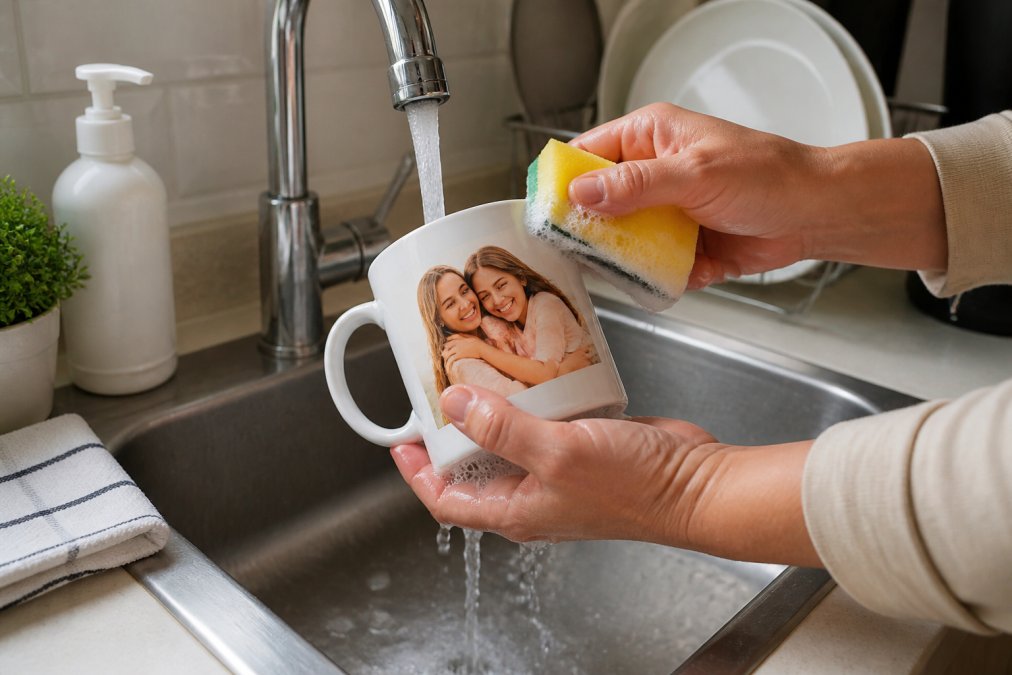
Hand Washing Step by Step
- Fill the mug with warm water, not hot. Hot liquid accelerates adhesive breakdown on surface-applied prints.
- Add a drop of mild detergent. Avoid anything labelled "heavy duty," "grease-cutting" or containing bleach.
- Wipe the interior with a soft sponge. Never use steel wool, scouring pads or abrasive cleaners on the printed exterior.
- Rinse the outside gently under running warm water, passing the sponge over the design once or twice.
- Air dry upside down on a rack, or dry with a soft cloth. Skip the tea towel if it's been used on greasy dishes.
Dishwashing Rules If You Must Use the Machine
Only run mugs you've confirmed are sublimation or kiln-fired. Place them on the top rack, away from knives and heavy items that can chip the surface. Use a mild detergent and select a low-temperature or eco cycle where available. Skip the heated drying cycle entirely, since sustained heat is what degrades most prints.
How to Prevent Mug Print Fading: Water Temperature, Detergent and Abrasion
Print fading is almost always caused by three factors working together: water temperature, detergent chemistry and physical abrasion. Control all three and your design outlasts the mug.
Water temperature matters more than most people realise. Most household hot water systems run between 60°C and 65°C, and at that range the adhesives in decal prints soften noticeably. Sublimation and kiln-fired prints tolerate it, but repeated exposure still shortens the life of any surface-applied design. For hand washing, aim for water you can comfortably hold your hand under.
Detergent choice is the second lever. Powdered dishwasher detergents are more abrasive than liquid or gel formulas, and many contain oxygen-based bleaching agents that attack printed colour. Liquid detergent in smaller doses does less damage.
Abrasion is the one people overlook. Stacking mugs inside each other, scrubbing with a rough sponge, or letting mugs rattle against plates all wear down the surface finish. A worn surface finish is where fading starts.
- Use liquid or gel detergent rather than powder
- Keep water below 65°C for hand washing
- Never stack mugs inside one another in the cupboard or the rack
- Wash printed mugs separately from sharp or heavy items
- Skip the dishwasher's heated dry setting
Microwave Safety and Thermal Shock: What Can Go Wrong
Microwave safety and dishwasher safety are separate questions, and a mug can pass one while failing the other. A mug that survives a dishwasher cycle may still crack, blister or spark in a microwave, because the two appliances stress it differently.
A dishwasher applies sustained heat, moisture and detergent over a long cycle; a microwave applies rapid, uneven heating from the inside out. That difference matters most when the mug is cold and the liquid is hot, or when the mug contains metal.
What Thermal Shock Actually Does to a Mug
Thermal shock is the sudden expansion and contraction of a material when its temperature changes quickly. Ceramic conducts heat poorly, so pouring boiling water into a cold mug makes the inside surface expand before the outside wall warms up, creating internal stress.
Most glazed ceramic handles moderate swings, but stress accumulates. A mug through hundreds of microwave cycles is more likely to develop hairline cracks in the glaze than one that has only held kettle water. Those cracks are where print fading often starts, because moisture and detergent reach the design layer through the compromised glaze.
Why Metallic Prints Are the Real Microwave Risk
Metallic print finishes, gold trim and foil detailing contain metal particles. In a microwave, metal reflects microwaves rather than absorbing them, causing arcing, sparking and localised heat. Even a thin foil layer can blister, lift or scorch.
The risk isn't limited to visible sparks. A metallic print can absorb enough concentrated heat to crack the glaze underneath it, even when you don't see anything happen during the cycle. The damage often shows up later as a cracked or discoloured patch.
A few practical rules:
- Never microwave a mug with metallic print, gold trim or foil detailing
- Avoid microwaving any mug straight from the fridge or a cold bench
- Let hot drinks cool slightly before pouring into a cold mug
- Check the base for a microwave-safe symbol before reheating anything
- If the mug has no marking at all, treat the microwave as off-limits
The Temperature Threshold That Matters
There's no single standard for "microwave safe," but a useful rule is that a mug should tolerate liquid up to around 100°C (boiling point) without the glaze or print degrading. Most quality ceramic bodies handle this; the failure point is usually the print layer, not the ceramic.
For dishwasher use, the relevant threshold is lower. Most household hot water systems deliver water between 60°C and 65°C, and dishwasher cycles can peak higher during the wash phase. That's why a mug can be microwave safe but not dishwasher safe, or vice versa. The two ratings test different things.
Most factory-produced novelty mugs, including the range at 123t Australia, are stamped dishwasher and microwave safe, meaning both the ceramic body and the print have been tested for heat exposure. If your mug lacks that marking, treat the microwave as off-limits.
When a Custom Printed Mug Starts Fading: Troubleshooting and Solutions
A fading print isn't always the end of the mug. What you do next determines whether the design stabilises or keeps degrading, and most care guides skip this entirely, assuming a faded print means a ruined mug.
Step 1: Diagnose What Kind of Fading You Have
The pattern of the fade tells you what caused it. Match your mug to one of these four scenarios.
Even colour wash-out across the whole design. The print is being attacked chemically, usually by dishwasher detergent. Oxygen-based bleaching agents in powdered detergents strip colour gradually and evenly. Switch to hand washing with mild soap immediately and the fade will typically stop progressing.
Edges lifting or flaking. You're dealing with a decal or vinyl transfer that's losing adhesion. There's no reliable fix for this at home. Once the adhesive fails, the design will continue to peel. This is the one scenario where the print is genuinely unrecoverable.
Fine cracks in a web-like pattern across the print. Thermal shock is the likely cause, usually from microwave use or pouring boiling water into a cold mug. The glaze has crazed and the print layer has cracked with it.
Patchy, blotchy fading in one area only. This usually points to physical abrasion, such as scrubbing one spot repeatedly, stacking the mug against another, or a dishwasher spray arm hitting the same spot every cycle.
Step 2: Stabilise the Print Before It Gets Worse
Once you've identified the cause, the goal is to stop further degradation. For chemical fading, abrasion and early thermal cracking, these changes usually halt the decline:
- Switch to hand washing with cool or lukewarm water
- Stop using powdered detergent entirely
- Avoid stacking the mug with others, in the cupboard or the rack
- Keep it out of the microwave
- Dry with a soft cloth rather than leaving it to air dry on a draining board where it can knock against other items
If the fade is even and mild, you may find the colour stabilises within a few washes and stays at that level for years. The design won't come back, but it won't disappear either.
Step 3: What You Can and Can't Restore
This is where most guides stop, and where the honest answer matters. There is no home method that reliably restores a faded sublimation or kiln-fired print. The dye sits inside the coating or the glaze, so you can't reapply colour to it without reprinting the mug.
What you can do depends on the print type:
- Sublimation or kiln-fired print with mild even fading: No restoration possible, but the mug remains fully usable and food-safe. The design is simply lighter than it was.
- Vinyl or decal print with lifting edges: You can sometimes press a lifting corner back down with gentle finger pressure while the mug is warm, but it will lift again. This is a temporary measure, not a fix.
- Surface-applied print with a small scratch: A tiny scratch in a vinyl print can sometimes be disguised with a matching permanent marker applied to the exposed area, but this is cosmetic only and won't survive washing.
- Print that has fully peeled or washed away: The mug is now a plain mug. It's still perfectly safe to drink from, and many people keep it as a spare.
Step 4: Decide Whether to Replace or Keep
If the mug was a gift or has sentimental value, keeping it as a plain mug is reasonable. If the design is the point, replacement is the only real solution.
The lesson worth carrying forward: the printing method determines everything. A sublimation or kiln-fired mug outlasts a vinyl decal mug by years, even with identical care. When you replace a faded mug, check the base for a stamped dishwasher-safe rating before you buy, that single check is the difference between months and years.
Caring for Metallic Prints, Photo Mugs and Travel Mug Designs
Metallic prints, photo mugs and travel mugs each need slightly different handling because of how their surfaces are constructed.
Metallic print mugs use a foil layer that reflects light and gives the design a shiny finish. That foil is delicate. It scratches easily, reacts badly to microwave heat and degrades faster than standard colour prints in the dishwasher. Hand wash only, and never use an abrasive sponge.
Photo mugs are usually produced with sublimation, making them dishwasher safe in most cases. The real risk is UV exposure rather than water: leaving a photo mug on a sunny windowsill for months fades the image faster than any dishwasher cycle. Store it in a cupboard rather than on an open shelf.
Travel mugs are a different category. Most have a stainless steel body with a printed outer sleeve, and while the steel is dishwasher safe, the print and lid seals often aren't. Hand wash the body and lid, and check whether the lid gasket is removable for separate cleaning, heat and detergent shorten the life of silicone seals.
For all of these, the care principle is the same: mild detergent, warm rather than hot water, soft sponge, air dry.
Frequently Asked Questions
Are custom printed mugs dishwasher safe?
It depends on the printing method. Sublimation-printed mugs have the design baked into the coating and are generally dishwasher safe. Kiln-fired ceramic mugs are also safe. But vinyl decals and some heat-transfer prints can peel or fade in a dishwasher. Always check the care instructions or test with a short cycle first.
How do I know if my personalised mug is dishwasher safe?
Look for a dishwasher-safe symbol on the base or bottom of the mug. If there is no symbol, check the product description or packaging. You can also test by washing it on a low-temperature, gentle cycle and checking for any change in the print. When in doubt, hand wash to protect the design.
What is the best way to clean a custom printed mug to prevent fading?
Hand wash with warm water, a mild detergent, and a soft sponge. Avoid abrasive scrubbers and harsh chemicals. Rinse thoroughly and dry with a soft cloth. If using a dishwasher, place the mug on the top rack and use a gentle, low-heat cycle. This keeps the print vibrant for longer.
Can I put a sublimation-printed mug in the dishwasher?
Yes, sublimation-printed mugs are typically dishwasher safe because the design is infused into the mug's coating under heat. However, repeated high-temperature cycles can eventually dull the colours. For maximum longevity, hand washing is still the gentlest option, but occasional dishwasher use is fine.

