

Last Updated: November 18, 2026
Quick Summary
Buying from small australian businesses keeps local jobs and money circulating in your community, since local spending has a multiplier effect through local suppliers, drivers and accountants. You also get personal service, flexible returns and accountability that big retailers can't replicate, though prices are often higher.
- Local spending has a multiplier effect as small businesses pay local suppliers, drivers and accountants.
- Small business wins on service, flexibility and accountability; big business wins on scale, range and price.
- Australian-made means the product was manufactured here, while Australian-owned means the business is owned by Australians.
- Check for an ABN, a real address and personal responses to confirm a business is genuinely local.
- At 123t Australia, shipping is free and personalised custom clothing and gifts come with a 60-day return policy.
Table of Contents
- 1. Local Jobs and Employment Stay Close to Home
- 2. Money Circulating Locally Keeps the Community Working
- 3. The Real Benefits of Supporting Small Businesses
- 4. Small Business vs Big Business: Where Each One Wins
- 5. Australian-Made Products: Why Origin Matters More Than a Label
- 6. Australian-Made vs Australian-Owned: Telling Them Apart
- 7. How to Support Small Businesses All Year Round
- 8. Product Quality, Craftsmanship and Sustainable Sourcing
- 9. Ordering a Gift From a Family-Run Australian Business
- Frequently Asked Questions
1. Local Jobs and Employment Stay Close to Home
Every dollar spent with small Australian businesses supports a local job. That's the simplest way to understand the benefits of buying from small Australian businesses: employment is the first thing your spending touches.
A local retailer hires locally. A family-run online store packs orders from a warehouse in its own suburb, staffed by people who live nearby. When you buy from them, the wages stay in the neighbourhood. When you buy from a global marketplace, the fulfilment happens somewhere else entirely.
At 123t Australia, we're a family-run operation. It's a small operation by design, and that's exactly the point.
2. Money Circulating Locally Keeps the Community Working
Local spending has a multiplier effect. A small business pays local suppliers, local delivery drivers, and local accountants. Those businesses then spend in the same community. The money circulates rather than leaving.
This is one of the most overlooked benefits of supporting small businesses. The economic contribution isn't just the initial sale, it's the chain of local transactions that follows it. A café buys its milk from a nearby dairy. A gift shop uses a local courier. A printer sources paper from an Australian supplier.
Compare that with a global platform where the margin flows offshore almost immediately. The purchase is convenient, but the economic resilience of the local community doesn't benefit in the same way.
Practical consumer trade-offs exist here. Local suppliers sometimes cost more because they don't have the same scale. But the money you spend tends to stay closer to home, and that's a real return.
3. The Real Benefits of Supporting Small Businesses
The benefits of supporting small businesses go well beyond warm feelings. They're concrete: better service, faster problem-solving, and relationships that big retailers can't replicate.
Repeat Customers and Relationships You Can't Get From a Marketplace
When you buy from a small business repeatedly, you become a known customer. That changes how problems get handled. A small retailer remembers your last order. If something arrives damaged, you're dealing with a person, not a ticket queue.
4. Small Business vs Big Business: Where Each One Wins
Big business wins on scale, range and often price. Small business wins on service, flexibility and accountability. Neither is universally better, and pretending otherwise doesn't help anyone.
Here's the honest comparison:
| Factor | Small Business | Big Business |
|---|---|---|
| Price | Often higher | Usually lower |
| Range | Focused, curated | Very broad |
| Service | Personal, direct | Scripted, layered |
| Returns | Flexible, judgement-based | Policy-bound |
| Accountability | Owner answers | Escalated through teams |
| Custom work | Common | Rare or unavailable |
The Honest Trade-Offs of Shopping Small
Small businesses can't always match big-box pricing. That's a genuine limitation, not a marketing line. Custom work takes longer than pulling a mass-produced item off a shelf. Stock levels are smaller. If you need something obscure in a hurry, a large retailer may be your only option.
The trade-off is worth it when service, customisation or accountability matter. It's less worth it when you just need the cheapest version of a commodity item. Knowing which situation you're in is the whole game.
5. Australian-Made Products: Why Origin Matters More Than a Label
Australian-made products often carry a higher standard of accountability.
Origin matters because it tells you something about the supply chain. A product made domestically is easier to verify, easier to hold to account, and usually subject to stricter workplace and environmental standards than goods manufactured in markets with looser rules. The ACCC guidance on country of origin claims sets out what businesses can and can't say about where a product was made, which gives buyers a legal backstop.
That said, "Australian-made" is a label, and labels get stretched. Some products use the term loosely. Checking the actual claim, not just the badge on the packaging, is the practical move.
6. Australian-Made vs Australian-Owned: Telling Them Apart
Australian-made and Australian-owned are not the same thing, and confusing them is one of the most common mistakes buyers make. A business can be Australian-owned while manufacturing overseas. A product can be made here by a company owned abroad.
Australian-owned means the business itself is owned by Australians. Australian-made means the physical product was manufactured here. Both have value, but they support different things. Ownership keeps business profits and decision-making local. Manufacturing keeps factory jobs and domestic industry local.
For gifts and apparel, the distinction matters. An Australian-owned brand designing in-house still keeps creative work and business growth onshore, even if some production happens elsewhere. If domestic manufacturing is your priority, ask specifically where the item is made rather than assuming ownership covers it.
7. How to Support Small Businesses All Year Round
Supporting small businesses isn't a Christmas-only activity. The businesses that survive are the ones with steady demand across the year, not just a December spike.
A few practical habits make a difference:
- Buy gifts from local makers for birthdays, not just holidays
- Follow small businesses on social media and share their posts
- Leave reviews after a good experience
- Choose a local supplier over a marketplace when the price difference is small
- Buy gift vouchers from small retailers instead of big chains
If you're short on time, there are last minute gift options from small local businesses that still keep your spending local.
Practical Ways to Check a Business Is Genuinely Local and Small
Not every business claiming to be local actually is. Here's how to check:
- Look for an ABN and check it's registered
- Read the About page for a real address and names
- Check whether reviews mention the same people and location
- See if the business responds to enquiries personally
- Confirm where the product is made, not just where the website is hosted
8. Product Quality, Craftsmanship and Sustainable Sourcing
Craftsmanship shows in the details. A small operator usually has tighter quality control because they're closer to production and their reputation depends on every order.
Sustainable sourcing is easier to verify at small scale too. A maker who sources locally can often tell you exactly where materials came from. That traceability is harder to maintain through a long global supply chain. Sustainability Victoria's guidance on sustainable procurement outlines how buying decisions can reduce environmental impact, and shorter transport distances are part of that picture.
Reducing transport distances cuts shipping and carbon emissions. It's not the whole environmental story, but it's a real factor, and it's one reason locally made goods often carry a lighter footprint.
If you want to weigh the cost question properly, it's worth reading whether personalised Australian gifts are worth the cost before deciding.
9. Ordering a Gift From a Family-Run Australian Business
Ordering from a family-run business feels different from checking out on a global marketplace. You're dealing with people who pack the order themselves and care whether it arrives right.
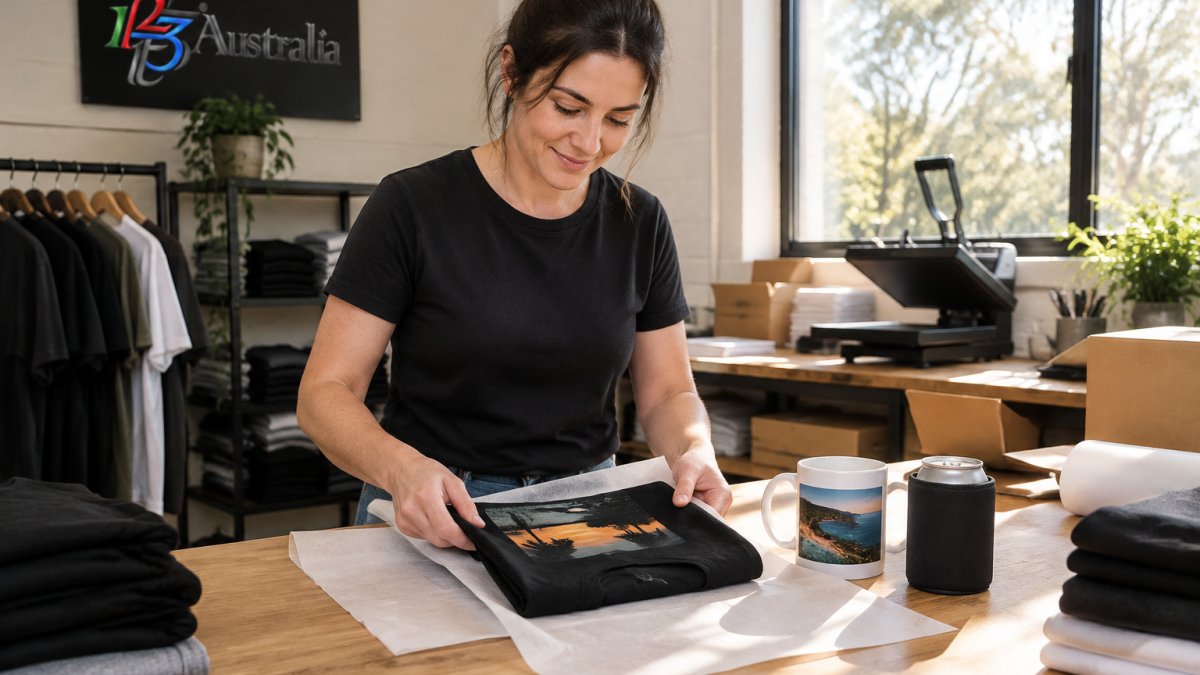
The woman is Australian.
At 123t Australia, we design our apparel and novelty gifts in-house, and shipping is free. Our personalised custom clothing and gifts come with a 60-day return policy, and our customers rate us 5.0. We're a family-run business.
If you're comparing options, it helps to understand the difference between marketplace sellers and local printers. Our guide on Redbubble vs local printers breaks down the trade-offs, and if you want examples of where to shop, here are some popular Australian brands for gift ideas. When you're ready to choose, we've covered ethical Australian gifts versus traditional souvenirs too.
Backing small Australian businesses isn't nostalgia, it's a practical choice with measurable returns for your community and often for you. If you want gifts that are designed here, made with care and backed by a real return policy, 123t Australia offers in-house designs, personalised custom clothing and gifts, free shipping and a 60-day return policy. Sign up and find something worth giving.
Frequently Asked Questions
What are the benefits of buying from small Australian businesses?
The main benefits are local jobs, money that stays in the community, and a direct relationship with the people who make or sell the product. Small operators often have a strong reason to fix problems, since they rely on repeat customers.
Is it more expensive to buy from a small business?
Sometimes the sticker price is higher, because a small operator cannot buy materials at the same volume as a large retailer. Look at what the price includes, such as the design, the personalisation and the returns policy. A cheap item that fades or arrives wrong costs more once you replace it. Compare total value rather than the headline figure, and ask the seller directly what sits behind the price.
What is the difference between Australian-made and Australian-owned?
Australian-made means the product was manufactured here and must meet the country-of-origin rules that apply to that claim. Australian-owned means the business itself is locally owned, even if the goods are produced overseas. Both support local employment in different ways: ownership keeps profits and decisions here, while manufacturing keeps production jobs here. A business can be one, the other, or both, so check which claim is actually being made before you assume.
How can I tell if a business is genuinely small and locally run?
Check the about page for a named owner, a physical address and a story you can trace. Look for an Australian Business Number, a local phone number, and reviews that mention specific products rather than generic praise. Social accounts with behind-the-scenes posts and replies to comments are a good sign. If the site only shows stock photos and a contact form with no location, treat the local claim with caution until you find more.


